Vendor Selection Tips: How to Choose the Right Outsourcing Partner
How to choose a call center or BPO partner: 11 vendor selection tips covering price, AI, talent, leadership, compliance, scale, references and implementation, plus the mistakes buyers make most often.

Alan started his career in contact centers, spending over a decade managing procurement, vendor partnerships, and operations for a large construction and hospitality company. In 2018, he co-founded Outsource Pros with his mother, Becky, to help businesses simplify outsourcing by connecting them with trusted partners.
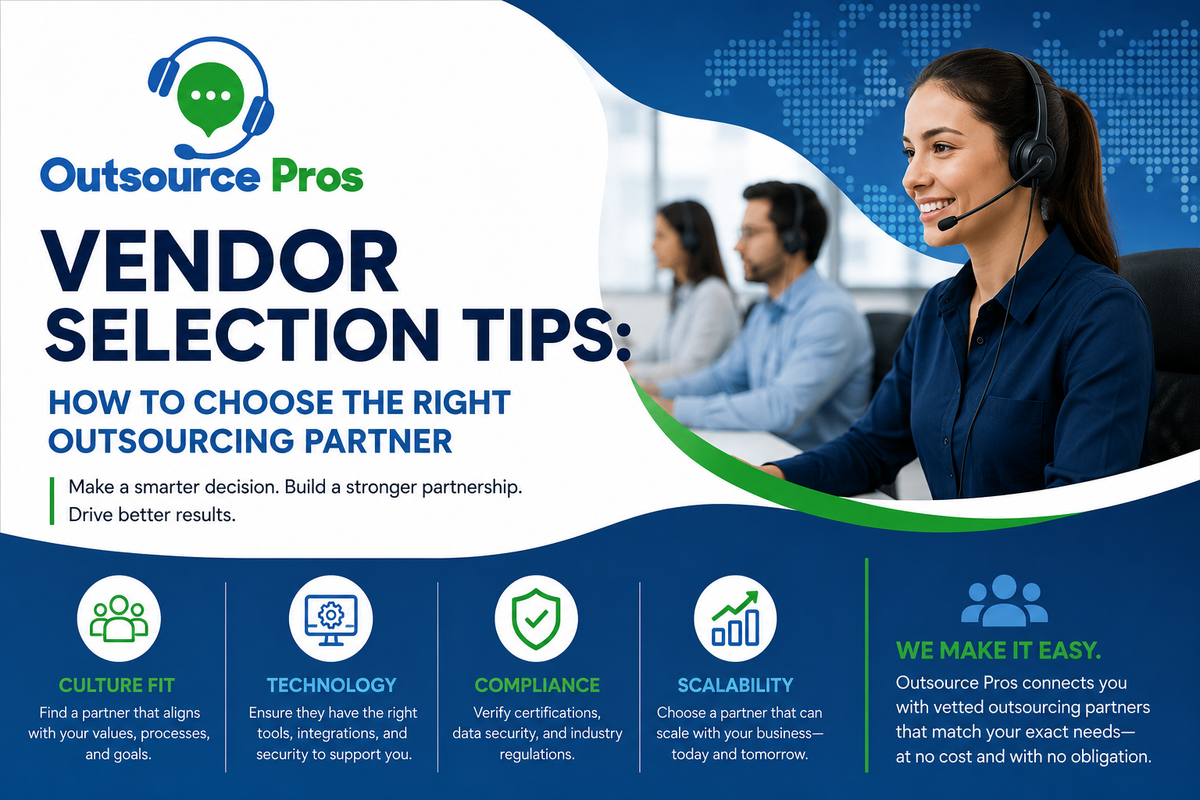
Choosing an outsourcing partner isn't hard because there are too few options. It's hard because there are too many, and most of them sound the same.
Search for contact center or BPO providers and you'll find hundreds of companies promising experienced agents, AI capabilities, high customer satisfaction and competitive pricing. Those claims don't tell you which partner will actually perform once your customers are on the line.
The question used to be "Which call center is cheapest?" Today it's "Which partner can actually deliver the outcomes we need?" The lowest price rarely delivers the lowest total cost, and a provider that struggles with quality, communication or scale can erase any savings within months.
This guide brings together the vendor selection tips we use when helping companies choose a call center or BPO partner, and the mistakes we see most often.
Why Vendor Selection Matters
Outsourcing affects far more than your operating costs. Your partner's agents talk to your customers, represent your brand and directly influence satisfaction, retention and revenue.
Choosing the wrong partner usually shows up as:
- Poor customer experiences and repeat contacts
- High agent turnover
- Missed service level agreements
- Security and compliance gaps
- More of your own team's time spent managing the vendor
- An expensive, disruptive transition a year or two later
By the time those problems are visible, switching is costly. Getting the selection right is far cheaper than fixing it afterward.
Start With Your Operating Model, Not a Vendor List
Most teams start by searching, comparing a few vendors, sending an RFP and hoping for the best. That approach skips the most important step.
Before you talk to a single provider, decide:
- Which work should be outsourced and which should stay in-house
- Which channels, languages and hours you need to cover
- Which skills and experience the work actually requires
- Which outcomes you will measure the partner against
The best providers no longer just supply agents. They manage customer journeys across channels, combine AI with human support and improve the process over time. But AI layered on top of a weak operating model produces faster responses with worse resolutions. Design the model first, then find the partner who can run it.
Vendor Selection Tips: What to Evaluate
1. Look Beyond the Hourly Rate
Price matters, but it should never be the deciding factor. A provider charging 20% less can look attractive until you discover high turnover, thin quality assurance, minimal training or weak reporting.
Look past the headline number:
- What is included in the rate, and what is billed separately?
- How does pricing change as volume grows or shrinks?
- What will poor performance cost you in repeat contacts, longer handle times, churn and internal rework?
Instead of asking "What is your hourly rate?", ask "What outcomes can you commit to, and how will we measure them?"
2. Match Industry and Use-Case Experience
Not all contact centers are built the same. Some specialize in healthcare, others in eCommerce, fintech, logistics or technical support, and experience varies by use case even within an industry:
- Customer support vs. sales
- Tier 1 vs. complex technical support
- Back office vs. voice
- Regulated vs. non-regulated work
Ask whether they have handled your exact type of work, at similar volumes and complexity, and whether they can show results from it. "Similar" is not the same as comparable.
3. Judge How They Use AI, Not Whether They Do
Every provider will say they use AI. What matters is how. Strong partners use it for real-time agent assist, quality review across all interactions, interaction analytics and smarter routing, and they know where it should not be used.
Ask:
- How does AI improve resolution, not just speed?
- How do agents work alongside the AI tools?
- What happens when the AI fails or needs to escalate?
- How does it integrate with your CRM and existing systems?
If the answers are vague, the AI is probably bolted on rather than built into the operation. Our analysis of why 74% of enterprises rolled back their AI agents covers the questions to ask in more depth.
4. Evaluate Hiring, Training and Culture Fit
Your customer experience is only as good as the agents delivering it. Look beyond headcount:
- How do they recruit and screen agents?
- What does onboarding and ongoing training look like?
- How are supervisors developed?
- What is their attrition rate, and what are they doing about it?
- How do they keep their culture intact as they grow?
A provider that works the way your organization works, with a similar communication style and expectations, usually becomes the stronger long-term partner.
5. Meet the Leadership Team, Not Just the Agents
Buyers often focus on agent turnover, but leadership stability usually has a bigger impact. Operations managers, training leads, QA teams and account managers are what make performance consistent. When they change frequently, processes and communication break down.
Ask:
- Who will be our day-to-day contact?
- How long has the proposed operations manager been with the company?
- What is the average tenure of supervisors and leadership?
- How often do account managers change?
The people who will run your program matter more than the people presenting the proposal.
6. Verify Compliance and Security
If you handle sensitive customer data, compliance cannot be an afterthought. Depending on your industry, confirm certifications and frameworks such as HIPAA, PCI DSS, SOC 2 or ISO 27001, and ask about:
- Data encryption and access controls
- Security monitoring and incident response
- Employee background checks
- Business continuity and disaster recovery
- Controls for remote and work-from-home agents
Healthcare buyers should go further. Our guide to HIPAA compliance in healthcare contact center outsourcing lists what a serious vendor should be able to produce on request.
7. Ask What Happens When Performance Drops
Many providers advertise high customer satisfaction. Ask them to explain exactly how they measure it: monitoring frequency, quality scorecards, coaching, and metrics such as CSAT, NPS, first contact resolution and handle time.
Then ask the more revealing question: what happens when service levels fall below target? No contact center delivers perfect results every month. The difference between average and great providers is how they respond. Look for:
- Root cause analysis
- Corrective action plans with defined timelines
- Additional coaching and training
- Weekly performance reviews
- Transparent reporting while the issue is being fixed
If the answer is vague or focuses on excuses instead of accountability, treat it as a warning sign.
8. Insist on Reporting That Tells You What's Wrong
You should never have to guess how your program is performing. Look for real-time dashboards, KPIs tied to outcomes rather than activity, regular business reviews and recommendations based on the data.
Most importantly, ask whether they will tell you what's going wrong, or only what looks good.
9. Test Scale and the Delivery Mix
Many providers perform well at small volumes, then struggle as they grow. Ask:
- What happens when we double volume?
- How have you handled seasonal spikes?
- Can you ramp quickly without lowering hiring standards?
- Which languages and locations can you support?
Location matters more than most companies expect. Onshore, nearshore and offshore each trade off cost, language and cultural alignment, time zone coverage and regulatory requirements. A good partner helps you design the right mix rather than pushing you toward the one location they happen to operate in. Our comparison of the best countries to outsource your call center is a useful starting point.
10. Talk to Current Clients
Case studies are helpful. Conversations with existing customers are better. Ask for two or three references with requirements similar to yours, ideally in your industry or at similar volumes, and ask them:
- What surprised you after implementation?
- How responsive is leadership when something goes wrong?
- Have service levels stayed consistent?
- Would you choose them again?
A provider that consistently delivers should have no trouble arranging these calls. These conversations often reveal what never appears in a proposal.
11. Get the Implementation Plan in Writing
Even an excellent provider can stumble if the launch is poorly managed. Ask for a detailed transition plan covering discovery, knowledge transfer, agent training, technology integration, a pilot, the launch timeline and ongoing governance. Our guide to building a BPO transition plan walks through each stage.
Large vs. Mid-Sized BPO Providers
There's a common belief that bigger is better. Large BPOs offer scale, but buyers often trade away attention: you become one of many accounts, with less flexibility and slower decisions.
Mid-sized and specialized providers often bring more senior attention to your program, faster adjustments and stronger ownership of results. The point isn't that smaller is always better. It's that size is not a proxy for fit. We explain why in why mid-size BPOs are the smart bet.
Common Vendor Selection Mistakes
- Choosing primarily on price
- Shortlisting from search results, where the largest marketing budgets rank highest, rather than from fit
- Comparing proposals instead of capabilities
- Evaluating only a handful of providers
- Skipping reference checks
- Overlooking culture and leadership stability
- Assuming AI will fix a weak process (it usually amplifies it)
- Not validating compliance requirements
- Treating the provider as a vendor to hand work to, rather than a partner to manage
- Rushing the decision because of staffing pressure
A Structured Way to Evaluate Providers
A repeatable process makes the decision more objective and easier to defend internally:
- Define your operating model and requirements first
- Build a long list based on capability and experience, not visibility
- Score every provider against the same criteria
- Run reference calls and site or virtual visits for the shortlist
- Compare total cost and committed outcomes, not just rates
- Agree governance, reporting and remedies before you sign
The Outsource Pros 7-point BPO vetting framework is the scoring model we use for that step.
Why Many Companies Use an Independent Advisor
Researching vendors, scheduling meetings, comparing proposals, checking certifications and references, and negotiating contracts can take weeks or months, and most teams don't have visibility into the full market.
An independent advisor shortens that process. At Outsource Pros we start from your requirements, introduce vetted providers that already fit them on experience, location, technology, compliance, language and budget, help you compare proposals and negotiate terms, and stay involved through implementation.
There is no cost to you. Our fee is paid by the provider you choose, not by you, and we work with many providers rather than representing one.
Final Thoughts
The best outsourcing decision isn't necessarily the lowest-cost provider or the largest global BPO. It's the partner that understands your business, is led by people who own the results, and has the people, technology and processes to support your growth.
Choosing a call center outsourcing partner is no longer just a procurement decision. It's a customer experience decision. The right partner becomes an extension of your brand. The wrong one creates problems you'll spend months fixing.
Ready to Find the Right Outsourcing Partner?
Tell us what you need, and we'll introduce you to the providers that best fit your business, at no cost and with no obligation. Book a free consultation to get started.