How to Build a BPO Transition Plan That Doesn't Disrupt Your Business
Most companies are not afraid of outsourcing. They are afraid of disruption. A poorly managed BPO transition can hurt customer experience, service levels, and internal operations fast. But the right transition plan can reduce risk while improving performance. In this new article, we break down the 4-phase framework used to successfully transition contact center operations without disrupting the business: Knowledge transfer and documentation Parallel running overlap period Structured cutover checklist Monitoring the first 90 days If you are evaluating a new BPO partner or planning to switch providers, this is one of the most important parts of the process to get right.

Alan started his career in contact centers, spending over a decade managing procurement, vendor partnerships, and operations for a large construction and hospitality company. In 2018, he co-founded Outsource Pros with his mother, Becky, to help businesses simplify outsourcing by connecting them with trusted partners.
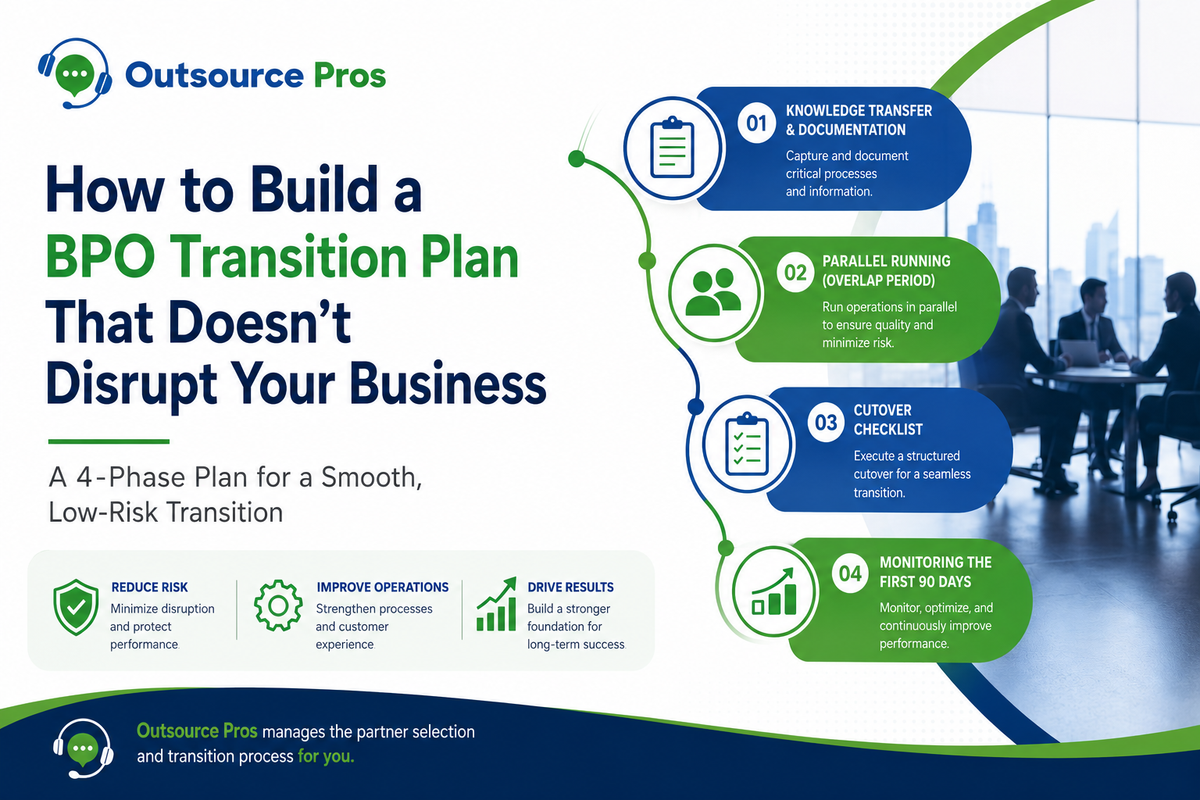
How to Build a BPO Transition Plan That Doesn't Disrupt Your Business
Switching BPO providers sounds simple on paper.
In reality, most companies delay outsourcing decisions for one reason: fear of disruption.
They worry about dropped customer satisfaction scores, missed SLAs, frustrated customers, operational confusion, and internal teams spending months fixing problems that should have been avoided in the first place.
And honestly, that fear is valid.
A poorly managed BPO transition can create serious operational damage. But a well-managed transition can improve service quality, reduce costs, and strengthen customer experience without interrupting day-to-day operations.
The difference is not the size of the vendor.
The difference is the transition plan.
At Outsource Pros, we help companies build structured transition strategies that reduce risk while keeping operations stable during the move to a new outsourcing partner.
Here’s the framework we use.
Why Most BPO Transitions Fail
Most failed outsourcing transitions have the same problems:
- Rushed timelines
- Poor documentation
- Incomplete knowledge transfer
- No overlap period
- Unrealistic staffing assumptions
- Weak communication between internal teams and the BPO
- No ownership of the transition process
Many companies also assume the new BPO will “figure it out” after launch.
That almost never works.
A successful BPO transition needs structure, accountability, and operational discipline from day one.
The 4 Phases of a Successful BPO Transition
Phase 1: Knowledge Transfer and Documentation
This is the foundation of the entire transition.
If this phase is weak, every phase after it becomes harder.
The goal is to transfer operational knowledge from your internal team or current BPO partner into a documented, repeatable process the new provider can execute consistently.
This includes:
- SOPs and workflows
- Call flows and escalation paths
- QA scorecards
- Compliance requirements
- System access and permissions
- Workforce management expectations
- Customer journey mapping
- Reporting structures
- KPI definitions
- Training materials
- Brand voice and communication standards
One of the biggest mistakes companies make is assuming knowledge exists because “the current team knows how to do it.”
That knowledge needs to be documented clearly before transition begins.
A strong partner will also identify operational gaps during this stage, not after go-live.
Phase 2: Parallel Running (Overlap Period)
This is where risk gets reduced dramatically.
Instead of shutting one operation down and turning another on overnight, both teams operate simultaneously for a controlled period.
The new BPO begins handling a portion of contacts while the existing operation remains active.
This overlap period allows you to:
- Validate training quality
- Monitor customer experience
- Test workflows
- Identify escalation issues
- Measure QA performance
- Compare KPIs between teams
- Adjust staffing models before full launch
This phase is critical because problems appear while the safety net still exists.
Companies that skip overlap periods usually discover issues after customers do.
Phase 3: Cutover Checklist
The cutover phase is where operational ownership officially shifts.
This is the highest-risk moment of the transition.
A structured cutover checklist prevents confusion and keeps accountability clear.
A proper checklist should include:
- Final staffing confirmation
- Schedule validation
- System access testing
- Routing verification
- Escalation ownership confirmation
- Reporting validation
- QA calibration completion
- Compliance sign-offs
- Internal communication plans
- Backup contingency procedures
Every owner should know exactly what they are responsible for before launch day.
No assumptions.
No last-minute scrambling.
No “we thought someone else handled that.”
Phase 4: Monitoring the First 90 Days
Most companies think the transition is finished after go-live.
In reality, the first 90 days determine whether the partnership succeeds long term.
This phase should include:
- Daily performance reviews during early launch
- Weekly operational reviews
- QA audits
- Customer satisfaction tracking
- SLA monitoring
- Staffing optimization
- Escalation trend analysis
- Workflow refinements
- Coaching and retraining adjustments
This is where operational stability gets built.
The goal is not perfection on day one.
The goal is controlled improvement with visibility and accountability.
Strong BPO partners expect optimization during the first 90 days. Weak partners disappear after implementation.
Common BPO Transition Mistakes (And How to Avoid Them)
Choosing Based Only on Price
The cheapest provider often becomes the most expensive after operational issues appear.
Transition experience matters.
Governance matters.
Operational maturity matters.
Rushing the Timeline
Aggressive timelines create avoidable mistakes.
A realistic transition plan gives teams time to train, validate processes, and stabilize operations before full launch.
Ignoring Internal Stakeholders
Operations, IT, compliance, workforce management, QA, and leadership all need alignment during a transition.
If communication breaks internally, the transition becomes harder externally.
Poor Documentation
If critical workflows only exist inside someone’s head, transition risk increases immediately.
Documentation should happen before training starts.
No Performance Baseline
You cannot measure success without knowing current performance metrics.
Before transition begins, establish baseline KPIs for:
- CSAT
- AHT
- Service levels
- QA scores
- FCR
- Escalation rates
- Attrition
- Productivity
This creates accountability during the transition process.
The Right BPO Partner Should Reduce Stress — Not Create It
The reality is that most companies do not switch BPO providers often.
And when they do, the stakes are high.
That’s why partner selection matters so much.
A good BPO provider can improve customer experience, operational flexibility, and cost efficiency.
The wrong one creates disruption that takes months to fix.
At Outsource Pros, we help companies identify vetted outsourcing partners that fit their operational needs, industry requirements, scale, geography, and customer experience goals.
But we do not stop at introductions.
We also help guide the transition process itself — from vendor selection through onboarding, launch, and post-go-live stabilization.
Because the goal is not simply outsourcing.
The goal is building a transition plan that protects your business while improving operations.
Ready to Explore Your Options?
Schedule a conversation with Outsource Pros to discuss your current operation, transition concerns, and what the right BPO strategy could look like for your business.