The Outsource Pros 7-Point BPO Vetting Framework
Skip trial-and-error in call center outsourcing: the 7-point framework we use to vet BPO partners across the U.S., nearshore, and offshore. Outsource Pros connects you with pre-vetted BPO partners that fit your exact needs — across the U.S., nearshore, and offshore — at no cost to you. No long RFPs. No guesswork. No wasted time.

Alan started his career in contact centers, spending over a decade managing procurement, vendor partnerships, and operations for a large construction and hospitality company. In 2018, he co-founded Outsource Pros with his mother, Becky, to help businesses simplify outsourcing by connecting them with trusted partners.
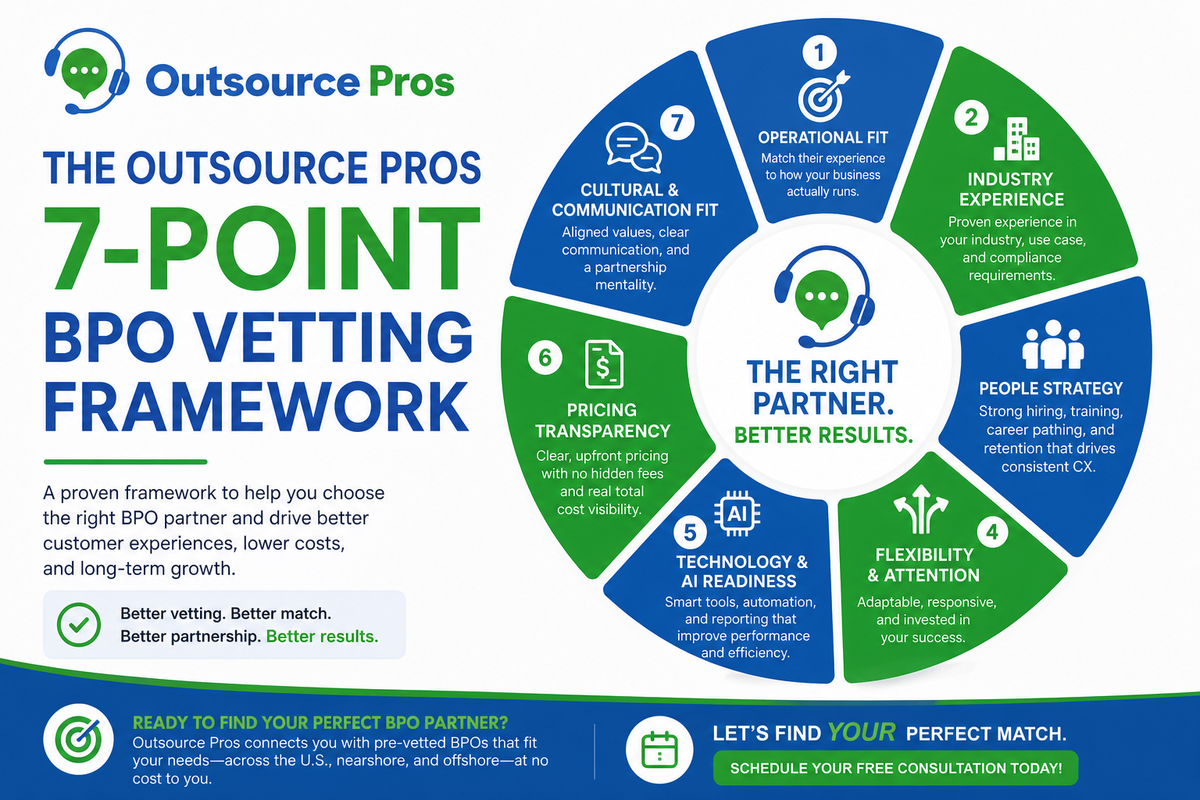
How to actually choose the right call center outsourcing partner (and avoid expensive mistakes)
Most companies don’t struggle to find BPO vendors.
They struggle to pick the right one.
On paper, many providers look the same. Strong decks. Big client logos. Competitive pricing. Promises around AI and automation.
But once you start working together, the gaps show up fast. Missed KPIs. Poor communication. High agent turnover. Slow ramp times.
We’ve seen it over and over.
That’s why we built a simple but strict vetting framework. It helps cut through the noise and focus on what actually matters when choosing a call center outsourcing partner.
Here’s how we do it.
1. Operational Fit (Not Just Capability)
Most BPOs can handle your work.
That doesn’t mean they should.
We look at how your operation actually runs:
- Ticket types and complexity
- Channels (voice, chat, email, back office)
- Volume patterns
- Escalation paths
Then we match that to providers who already run similar programs.
Not “they’ve done something close.”
But real, current experience.
Because the fastest way to fail is forcing a provider to learn your business on your time.
2. Industry Experience That Matters
A lot of vendors claim “multi-industry experience.”
That usually means surface-level exposure.
We go deeper:
- Have they handled your exact use case?
- Do they understand your compliance requirements?
- Have they worked with similar customers?
Healthcare, fintech, and e-commerce all have very different expectations.
And if a BPO doesn’t understand the details, your customers will feel it.
3. People Strategy (The Part Most Companies Miss)
This is where most outsourcing decisions go wrong.
We look at:
- Hiring profiles
- Training programs
- Agent retention
- Career pathing
Because your CX is only as good as the people handling it.
Some mid-sized BPOs outperform large providers here. They hire more selectively, train better, and keep agents longer.
That consistency shows up in your customer experience.
4. Flexibility and Attention
Large BPOs bring scale.
But scale often comes with trade-offs.
You can become just another account in a long list.
We look for:
- How fast they adapt
- How involved leadership is
- How willing they are to adjust processes
Many mid-sized providers win here. They move faster and stay closer to your business.
And that matters when things change — because they always do.
5. Technology and AI Readiness
Every BPO talks about AI now.
But there’s a big difference between:
- Talking about AI
- And actually using it inside operations
We look at:
- QA automation
- Real-time agent assist
- Workflow automation
- Reporting and analytics
More importantly, we look at how AI fits into the workflow.
Because adding AI to a broken process just creates faster problems.
6. Pricing Transparency (Beyond the Hourly Rate)
Low hourly rates can be misleading.
We break down:
- What’s included vs extra
- Management layers
- Tech costs
- Ramp and training fees
Then we compare that to expected performance.
Because the cheapest option upfront often becomes the most expensive later.
7. Cultural and Communication Fit
This is harder to measure, but easy to feel.
We assess:
- Communication style
- Time zone alignment
- Language fluency
- Problem-solving approach
If communication feels off during the sales process, it won’t improve after launch.
And misalignment here creates friction fast.
Why This Framework Matters
Choosing a BPO partner isn’t just a vendor decision.
It’s an operational decision that impacts your customers, your team, and your growth.
The wrong choice slows everything down.
The right one becomes an extension of your business.
And the difference usually comes down to how well the vetting was done upfront.
Final Thought
You don’t need more vendor options.
You need better matches.
That’s the gap most companies struggle with — and where the real risk is.