Why 74% of Enterprises Rolled Back Their AI Agents — and How to Choose a Contact Center Partner Whose AI Actually Works
74% of enterprises have rolled back AI customer-service agents. An independent BPO advisor explains what went wrong — and the questions to ask before you buy AI-enabled CX

Alan started his career in contact centers, spending over a decade managing procurement, vendor partnerships, and operations for a large construction and hospitality company. In 2018, he co-founded Outsource Pros with his mother, Becky, to help businesses simplify outsourcing by connecting them with trusted partners.
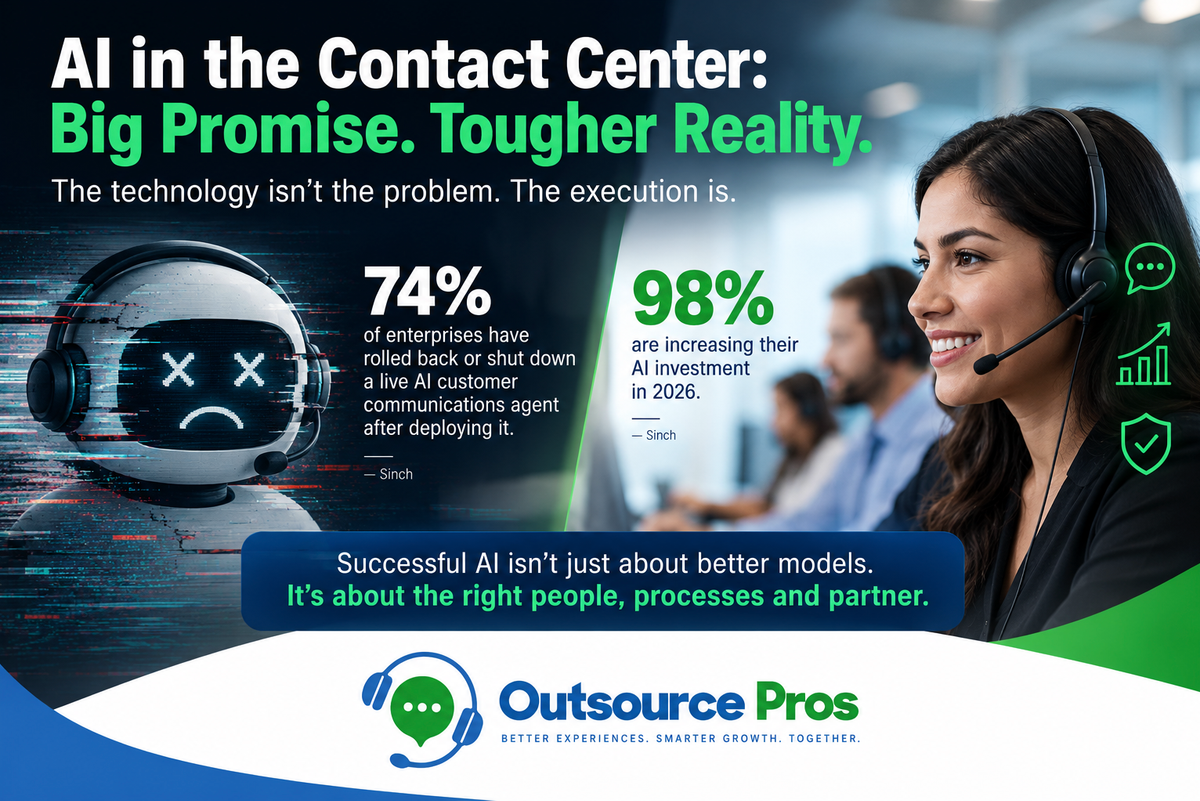
The AI contact center transformation story has hit an awkward chapter. According to new research from Sinch, 74% of enterprises have rolled back or shut down a live AI customer communications agent after deploying it. Not paused a pilot — pulled a production system that was already talking to their customers.
Here’s the paradox: the same study found that 98% of those enterprises are increasing their AI investment in 2026. Nobody is giving up on AI in customer experience. They’re discovering — expensively, and in front of customers — that deploying it well is much harder than the demos suggest.
If you’re evaluating outsourcing partners right now, every BPO on your shortlist is pitching an “AI-enabled” solution. This is the moment to get skeptical about what’s behind that label. Because the difference between the AI deployments that stick and the 74% that get rolled back usually isn’t the technology — it’s the operational discipline of the team running it.
What the rollback wave is really telling us
The Sinch study surveyed more than 2,500 senior decision-makers across ten countries and six industries, so this isn’t a story about a few clumsy early adopters. And the most interesting finding is counterintuitive: organizations with mature AI governance rolled back at a higher rate (81%) than the average. The companies watching their AI closely caught the failures. The scary question is what’s happening at companies that aren’t watching.
Gartner points at the same iceberg from a different ship: it predicts that over 40% of agentic AI projects will be canceled by the end of 2027, citing escalating costs, unclear business value, and inadequate risk controls. Meanwhile, back in the Sinch data, 84% of AI teams report spending half or more of their time on safety infrastructure — the unglamorous plumbing around the model, not the model itself.
The pattern across both: AI agents don’t usually fail because the underlying technology is weak. They fail because they’re deployed without the guardrails, escalation paths, integration depth, and human oversight that customer conversations demand. That’s an operations problem. And it should change how you shop for an outsourcing partner.
The new buyer’s question: not “do you have AI?” but “show me it working”
Two years ago, an AI slide in a BPO’s pitch deck was a differentiator. Today it’s table stakes — every provider claims an AI-enabled offering, from chatbots and agent-assist to fully agentic voice. The rollback data tells you that many of those offerings have never survived contact with real customer volume.
When we run vendor evaluations for clients, these are the questions that separate providers with production-grade AI from providers with a good demo:
- Which of your clients run this AI in production today, and at what volume? Ask for tenure, not logos. An AI agent that has handled two million conversations over 18 months is a different asset than one launched last quarter.
- What does your human escalation path look like — and how fast is it? The deployments that get rolled back are usually the ones that trapped frustrated customers in a bot. Ask for containment rates and escalation times, and ask how the AI decides it’s out of its depth.
- Who owns quality and compliance monitoring for AI conversations? Roughly half of contact center leaders say AI creates compliance risk. If the provider QAs its human agents but merely spot-checks the bot, that’s backwards — the bot handles more conversations.
- What happened the last time your AI got something wrong? Every production AI has failed at something. A provider that can walk you through a specific incident, what it cost, and what they changed is showing you their operational maturity. A provider that says it hasn’t happened is showing you they haven’t looked.
- How does the AI integrate with our systems — really? An agent that can’t see order history, account status, or your knowledge base can only deflect, not resolve. Integration depth is the strongest predictor of whether AI creates resolution or just friction.
- How do you price AI-handled interactions? If automation is doing more of the work, your commercial model should reflect it. Providers confident in their AI will put outcomes — resolution, CSAT — into the pricing conversation. Providers who won’t are telling you something.
Transformation is a sequencing problem, not a procurement problem
The other lesson from the rollback wave: successful AI contact center transformation is staged. The deployments that survive tend to start with agent-assist and after-call automation (where a mistake costs seconds, not customers), prove containment on a narrow set of intents, and expand only as the data supports it. The deployments that get pulled tend to start with a big-bang customer-facing launch, because that’s what made the business case exciting.
A good outsourcing partner will propose the boring, staged path and show you the measurement plan that goes with it. If a provider’s proposal jumps straight to “the AI handles 60% of your volume in month one,” the 74% statistic is your base rate for how that ends.
Where independent advice fits
This is exactly the evaluation problem an independent advisor exists to solve. Because we’re not selling the technology, we can pressure-test every provider’s AI claims against their actual production record — across our network of 1,000+ vetted contact center and CX providers — and match you with partners whose AI is proven in environments like yours, at no cost to you.
The enterprises rolling back their AI agents aren’t wrong about AI. They’re learning in production what buyers can learn in procurement: the provider matters more than the model. If you’re weighing AI-enabled outsourcing options — or wondering whether your current provider’s AI story holds up — book a free consultation and we’ll help you ask the right questions before you sign, not after.
Sources: Sinch — AI Production Paradox · Gartner — 40%+ of agentic AI projects canceled by 2027