Everyone Says AI Is Gutting Philippine BPO. The People Running It Don't.
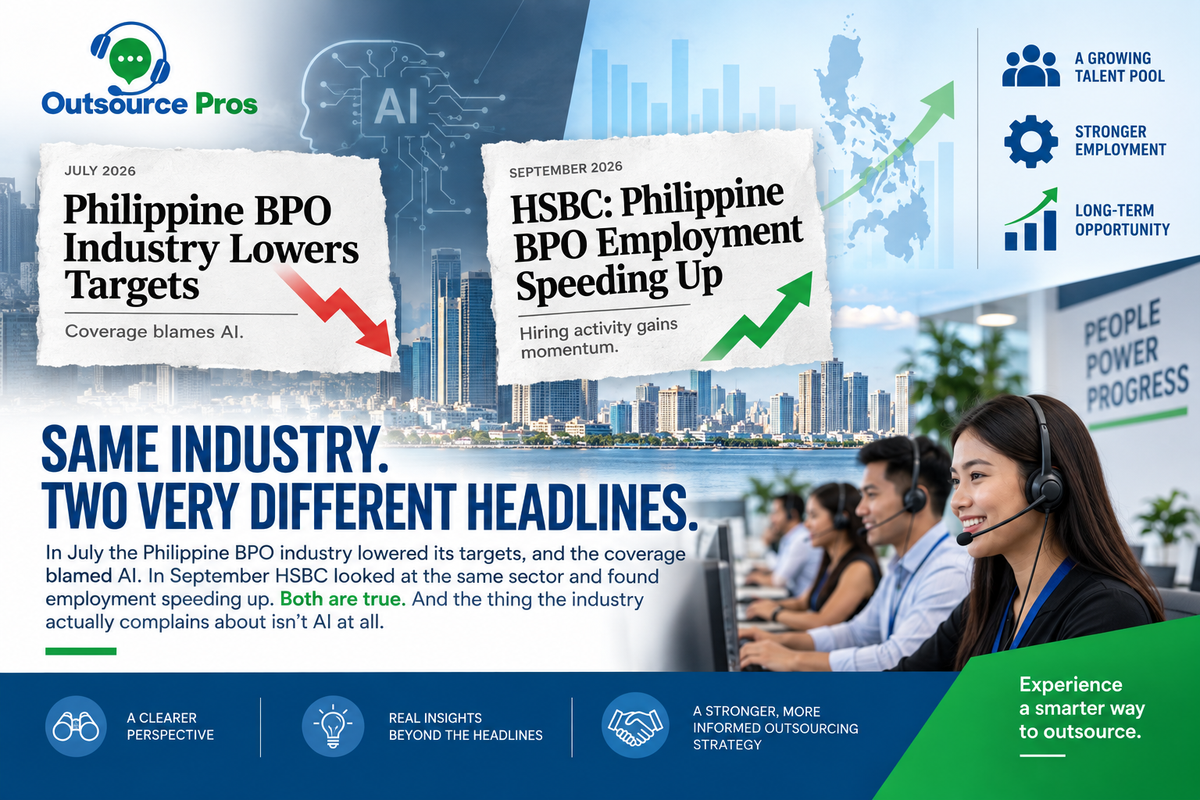
In July the Philippine BPO industry lowered its targets, and the coverage blamed AI. In September HSBC looked at the same sector and found employment speeding up. Both are true, and the thing the industry actually complains about isn't AI at all.

Alan started his career in contact centers, spending over a decade managing procurement, vendor partnerships, and operations for a large construction and hospitality company. In 2018, he co-founded Outsource Pros with his mother, Becky, to help businesses simplify outsourcing by connecting them with trusted partners.
Almost every week now, somebody asks me some version of the same question.
"Isn't AI about to make all of this obsolete?"
It's a fair thing to ask. The headlines have been rough.
In July the Philippine BPO industry lowered its growth targets for 2028, and most of the coverage pinned it on AI.
Then in September, HSBC looked at the exact same sector and said employment there was speeding up.
I went and read both.
They don't actually disagree. And what you find when you put them side by side is a lot more useful to you than either headline.
They cut the goal, not the growth
Back in 2022 the Philippine industry association set a target of 2.5 million jobs by 2028.
This summer they walked it back. Even their optimistic case now lands under 2.2 million.
That's a real climbdown and it deserved the coverage it got.
But here's what mostly didn't get written.
In the new plan, headcount still goes up. Every year. This year is bigger than last year, next year is bigger than this one, and 2028 is bigger than all of them.
They didn't predict a shrinking industry.
They predicted a slower-growing one, and then got called a shrinking one.
Those are really different stories. Easy to blur in a headline.
Expensive to blur when you're deciding where to put your program.
The guy who cut the target doesn't blame AI
This is the part that stopped me.
Jack Madrid runs the association that made the cut. Here's what he said at the briefing announcing it:
"I think AI is a real development, but I think we have not really seen it scale yet."
And on people losing jobs to it:
"AI has affected some jobs… but for entry-level jobs that some of the AI trials have affected, those employees were able to be redeployed."
Think about who's talking.
He'd just lowered his own industry's forecast. If AI were quietly eating the sector, he has every reason to say so. It would explain the cut for him.
He said the opposite.
A bank looked at the same sector and found the opposite of a crisis
In early September, HSBC's chief Asia economist, Frederic Neumann, published a note on Philippine services.
His line: there has been no "apocalypse" in services jobs in the Philippines — "if anything, employment has accelerated."
I liked that he didn't oversell it.
He put up two possible explanations and refused to pick one. Maybe AI just hasn't landed yet. Or maybe — and this is the one worth sitting with — AI actually helps offshore delivery.
Makes your people more productive.
Makes quality easier to watch.
Makes doing the work remotely more practical, not less.
Nobody is writing that second version. It's the one I'd bet on.
It also lines up with something we wrote about earlier this year: 74% of enterprises rolled back their AI agents, and the ones that pulled back hardest were the best-governed. Scaling AI is turning out to be slower and more careful than the headlines suggest.
So who's right?
Both of them. It isn't even close to a contradiction.
The industry association is saying it'll grow slower than it hoped back in 2022. HSBC is saying it's still growing.
Neumann says it outright: slower than before the pandemic, but still expanding at a healthy clip and "not stumbling as some might have feared."
Slower growth is not decline.
That's the whole trick of it.
What they're actually worried about is boring
If you want to know what's really keeping that industry up at night, don't read the AI takes. Read what they list as the things that could make their bad scenario happen.
Madrid named four. Government policy that scares off investors. Whether there's enough skilled talent. Infrastructure quality. How hard it is to do business there.
Three of those four have nothing to do with AI.
Their chief operating officer, Celeste Ilagan, was even more direct. Companies already operating in the Philippines who could expand further are "hampered by some policy and regulatory challenges" and are "having second thoughts."
She pointed at local government — clients keep asking about "the growing difficulty of dealing with our local government units."
And at insider cybercrime.
That's permits, red tape, and somebody on the inside walking off with your data.
None of it makes a good headline.
All of it will absolutely wreck your program.
The squeeze is competition, not robots
Madrid said something else that got almost no attention.
Buyers are taking longer to commit to offshore work. And he named exactly who the Philippines is losing those slow decisions to: South Africa, Egypt, Poland, Vietnam, Colombia, Costa Rica. India's still the biggest player overall.
That's the actual story.
Your work isn't vanishing into a model. It just has more places it could go, and buyers like you are being pickier about which one.
"The challenge before us," Madrid said, "is whether we can move fast enough to capture this next wave of opportunities."
That's a competitiveness problem.
Totally different animal from an automation problem. And it changes what you should be asking.
Four questions I'd put to your provider
If your real risk is regulatory and competitive rather than technological, then "what's your AI roadmap?" is a waste of a good question.
Try these instead. They're the same instincts behind our 7-point vetting framework, pointed at one country.
Which local governments are you operating under, and have you hit permitting or compliance snags in the last year and a half? Their own COO says this is one of the top complaints members bring her. I have never once heard a buyer ask it.
When your AI tools absorbed somebody's work, where did that person go? Madrid says people got redeployed. Ask your provider what they redeployed into, and how many are still there.
You'll learn very quickly whether their AI story is real or a slide deck.
How do you handle insider risk? Named directly by industry leadership as a sector problem. Ask about access controls, monitoring, and how deep the screening goes.
Certifications alone won't tell you.
If we put this in Colombia or Poland instead, what would we be giving up? A provider who can answer that honestly is thinking about your requirements.
One who can't is just selling you a location.
What I think is really going on
The Philippines isn't being automated out of existence.
Its own industry group lowered its forecast. A major bank found employment picking up. The person who announced the cut says AI hasn't even scaled yet.
All three of those are true at once.
What changed is that the market got crowded and buyers got slow. And the risks the industry names about itself are unglamorous — policy, infrastructure, local bureaucracy, somebody on the inside walking off with your data.
Boring risks are still the ones that kill programs.
So if you're weighing offshore delivery right now, spend less energy worrying about whether AI is coming for your vendor.
Spend it on whether that vendor can operate cleanly where they are.
One of those questions is interesting. The other one is the one that'll cost you.
That's a big part of what we do at Outsource Pros.
We work across a network of vetted contact centers in the Philippines, Latin America and elsewhere, and we evaluate them from the buyer's side — the things that don't always make it into the sales presentation. What the local operating picture actually looks like. What happened to the people their automation displaced. How they behaved on a program that struggled.
There's no cost to the client.
If you're weighing an offshore program, or rethinking one you already have, let's talk. We'll look at it with you and tell you what we see.