Stop Choosing an Outsourcing Country. Start Designing an Outsourcing Strategy.
Companies still start outsourcing projects by picking a country. The better approach: start with what the work requires, and let the requirements decide the map.

Alan started his career in contact centers, spending over a decade managing procurement, vendor partnerships, and operations for a large construction and hospitality company. In 2018, he co-founded Outsource Pros with his mother, Becky, to help businesses simplify outsourcing by connecting them with trusted partners.
One of the first things I hear when a company starts looking for a contact center is:
“We want to go nearshore.”
Or:
“We’re thinking about the Philippines.”
Sometimes they’ve already narrowed it down further. Mexico. Colombia. South Africa.
I understand why. For years, outsourcing decisions have been framed around geography. Pick a country, find a few providers there, compare pricing, and make a decision.
But I think that approach is becoming outdated.
The better question isn't:
Where should we outsource?
It's:
Which work should go where?
Those sound like similar questions. They're not.
One contact center doesn't mean one location
Liveops, a BPO provider, published a case study about a property-and-casualty insurer that moved from a U.S.-only operation to a combination of the U.S., Mexico and the Philippines.
The company reported roughly 30% savings in Mexico and 50% in the Philippines compared with its U.S. operation.
Those savings aren't particularly surprising. Labor arbitrage has been one of the main reasons companies outsource for decades.
What I found more interesting was what happened when demand increased unexpectedly.
The distributed operation was reportedly able to flex to roughly 150% of unexpected volume during major spikes.
The company didn't just create a cheaper contact center.
It created options.
Different work has different requirements
Imagine you have a 300-agent customer service operation.
It probably doesn't consist of 300 people doing exactly the same thing.
You may have agents handling basic account questions.
Another group handles billing.
Another handles retention.
Some handle escalations.
Others need specialized training.
Maybe you need English and Spanish.
And perhaps a smaller group handles customers where the value or complexity of the interaction makes experience more important than saving a few dollars per hour.
Why should all of those functions automatically sit in the same country?
They shouldn't.
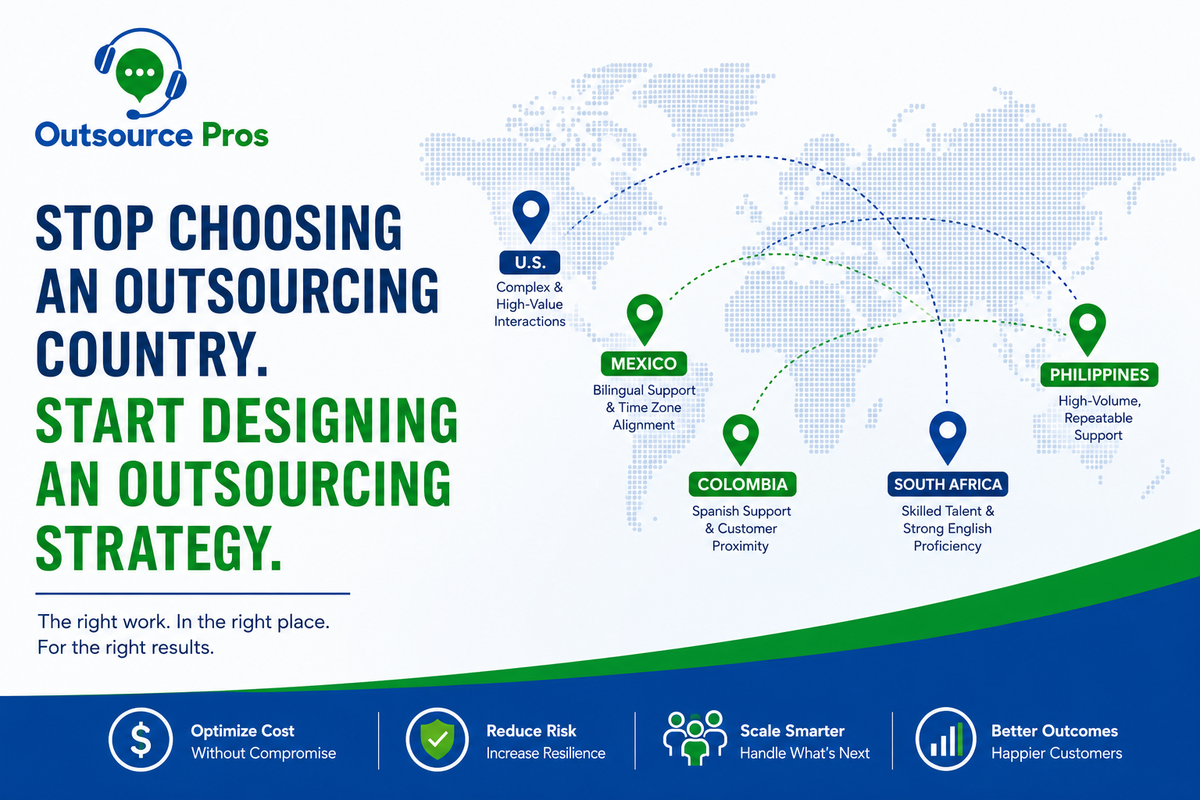
A company could keep complex or sensitive interactions in the U.S. while placing bilingual support in Mexico or Colombia.
High-volume, repeatable work might make sense in the Philippines.
Another part of the operation could go to South Africa because of its talent pool, English proficiency and time-zone coverage.
I'm not saying that's the right model for every company.
I'm saying the model should come from the requirements.
The work determines the location.
Not the other way around.
Cost still matters. It just shouldn't make the entire decision.
Let's be realistic.
Companies outsource because economics matter.
If a program costs $10 million annually and you can deliver the same or better customer experience for $7 million, that's significant.
But the cheapest location isn't necessarily the cheapest operation.
I've seen companies focus heavily on hourly rates while giving far less attention to things like:
- Attrition
- Recruiting
- Training time
- Management quality
- Language requirements
- Infrastructure
- Employee transportation
- Time-zone coverage
- Regulatory requirements
- Business continuity
- Scalability
A location can look great on a spreadsheet and become much less attractive once the program is running.
That's why I don't think companies should start an outsourcing project by asking for rates from five countries.
Start with the operation.
Then figure out where it belongs.
There's another reason to spread the operation around
Risk.
Putting an entire customer service operation in one location creates concentration risk.
Weather happens.
Political conditions change.
Internet and power infrastructure can fail.
Labor markets tighten.
Regulations change.
And sometimes you simply have a massive spike in customer demand that nobody predicted.
If 100% of your outsourced customer support sits in one building, with one provider, in one country, you have fewer options when something goes wrong.
A distributed model can give you another layer of protection.
That doesn't mean taking 100 agents and randomly putting 25 people in four countries.
Splitting an operation unnecessarily can create its own problems.
You need enough scale in each location to support leadership, training, workforce management and quality.
But once an operation becomes large enough, geographic diversification deserves to be part of the conversation.
The provider matters just as much as the country
There's another mistake I see when companies become too focused on geography.
They start treating providers within a country as interchangeable.
They're not.
Two contact centers five miles apart can perform completely differently.
One may have excellent recruiting and terrible operations.
Another may have strong leadership but high attrition.
One may specialize in healthcare.
Another may be great at e-commerce but have very little experience with regulated customer interactions.
One may tell you they can hire 100 people in 60 days because they actually can.
Another may tell you the same thing because they want the contract.
The country doesn't run your contact center.
The provider does.
And ultimately, the people inside that provider do.
Start with the requirements
Before deciding where an operation belongs, I'd answer a few questions first.
What kind of interactions are these agents handling?
How complex are they?
What languages are required?
What hours need to be covered?
How quickly does the operation need to scale?
How much seasonality is involved?
What regulatory or compliance requirements exist?
What systems will agents access?
How important is cultural familiarity with the customer?
What happens when volume suddenly increases 30%, 50% or even 100%?
And, of course:
What does the operation need to cost?
Once those questions are answered, geography becomes much easier to evaluate.
You might discover that Mexico makes the most sense.
You might discover the Philippines does.
You might decide everything should remain in the U.S.
Or you might realize that the best answer is all three.
This also changes how companies should select BPOs
If you're looking for one provider in one country, the sourcing process is relatively straightforward.
But if you're designing a global delivery strategy, it gets more complicated.
Now you're comparing countries, labor markets, providers, pricing structures, capabilities, languages, infrastructure and operating models at the same time.
And a provider with operations in ten countries isn't automatically the answer either.
There can be value in using multiple providers.
One BPO may have an exceptional operation in Colombia while another has a much stronger team in the Philippines.
Why force the entire program into one provider's network simply because it's convenient?
The objective shouldn't be to find the provider with the most flags on its website.
It should be to find the best operation for each part of your business.
That's a big part of what we do at Outsource Pros.
We work across a network of vetted contact centers in the U.S., nearshore and offshore markets. Instead of starting with a particular provider or country, we start with what the company actually needs.
Then we narrow the market down from there.
There's no cost to the company for our help, and we're not limited to recommending one geography or one type of provider.
That matters because sometimes the answer really is one contact center.
And sometimes it's not.
The outsourcing map is getting bigger
There was a time when outsourcing customer service often meant making a fairly simple decision.
Keep it domestic or send it offshore.
That's not the market anymore.
Companies have mature contact center options across the U.S., Mexico, Colombia, El Salvador, Jamaica, South Africa, the Philippines, India and many other markets.
Each has strengths.
Each has weaknesses.
And each can make sense depending on the work.
So if you're starting an outsourcing project, I wouldn't begin by asking:
“Which country should we choose?”
I'd start with:
“What does our operation need?”
Answer that well, and the map starts drawing itself.
If you're working through that question now, book a free consultation and we'll map it with you.