Mexico vs Colombia Call Centers: The 2026 Cost Math Changed
In January 2025 a dollar bought about 4,400 Colombian pesos. By mid-September it bought about 3,070. Mexico and Colombia both got more expensive for U.S. buyers this year, Colombia about twice as fast. Here's how I'd choose between them now, and what I'd put in the contract.

Alan started his career in contact centers, spending over a decade managing procurement, vendor partnerships, and operations for a large construction and hospitality company. In 2018, he co-founded Outsource Pros with his mother, Becky, to help businesses simplify outsourcing by connecting them with trusted partners.
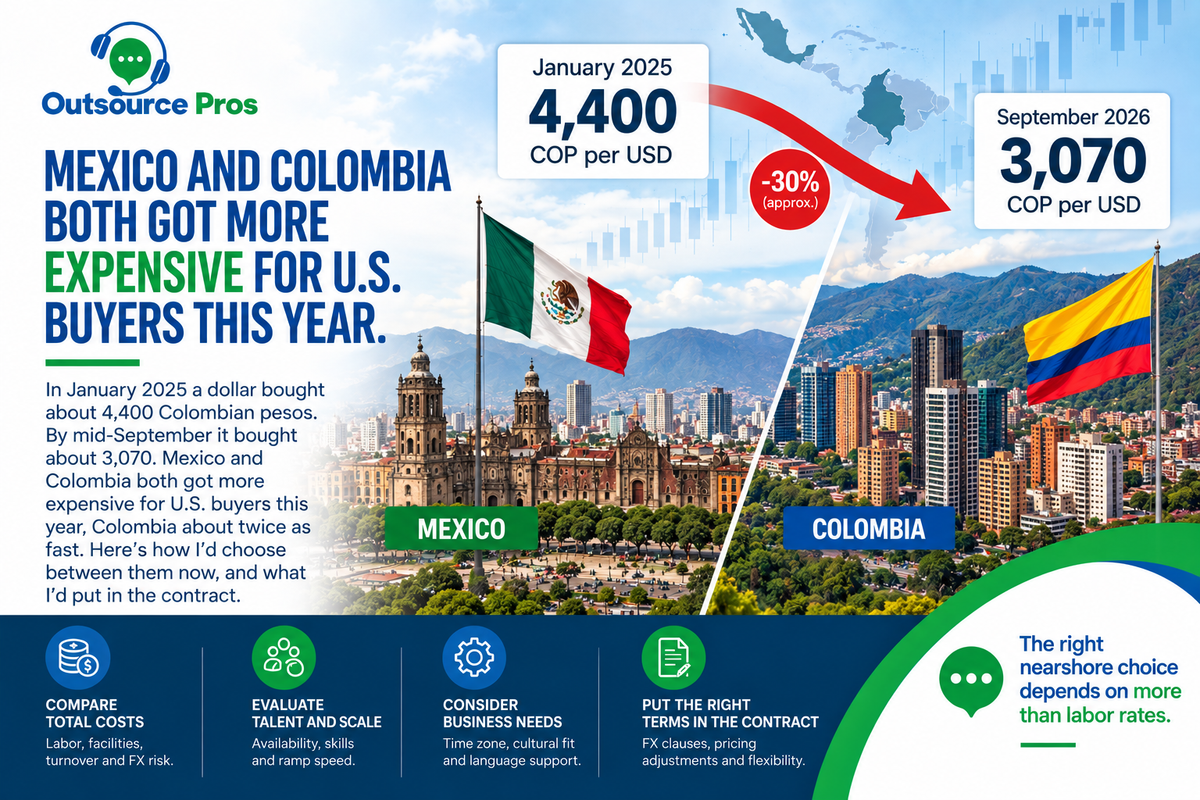
In January 2025, a dollar bought about 4,400 Colombian pesos.
In mid-September 2026, it bought about 3,070.
If you run a call center program in Colombia, or you're thinking about starting one, that's probably the most important number you'll see this year.
It isn't on anybody's rate card. It shows up anyway.
When a company tells me they want to go nearshore, Mexico and Colombia are usually the first two names on the list. And most of the comparisons you'll find online were written for last year's prices.
A lot moved since then.
The short version
If you just want the answer, here it is.
Mexico makes more sense if your program is large or has to grow fast, if a lot of your Spanish-speaking customers are Mexican-American, or if your team needs to be on the floor often.
Colombia makes more sense for a mid-sized bilingual program, especially if your Spanish-speaking customers come from all over Latin America and most of your hours are weekday daytime.
Both makes sense if you're big enough that trouble in one country would really hurt.
The rest of this post is why. And why last year's math doesn't hold anymore.
Colombia got more expensive three ways at once
The exchange rate is only the first one.
The peso got a lot stronger. It gave some of that back after the Federal Reserve raised rates on September 16, and it's been trading around 3,300. Still nowhere near where it was.
Here's why that matters to you. Your provider pays its agents in pesos. It bills you in dollars. When the peso gets stronger, every peso of payroll costs more dollars.
The minimum wage jumped. Colombia raised its minimum wage 23% for 2026, to 1,750,905 pesos a month. A court suspended the decree for a while, but the government reissued it at the same amount and the suspension was lifted in July. The wage itself never changed.
The labor rules got tighter. The legal work week dropped to 42 hours on July 15, so covering the same schedule takes more paid hours or more people. The premium for Sunday and holiday work went to 90% on July 1, and it goes to 100% next July. And night pay now starts at 7 p.m. instead of 9.
Put the currency and the minimum wage together and you get a number worth sitting with. In dollar terms, Colombia's minimum wage costs roughly 64% more than it did in January 2025.
Good bilingual agents earn well above the minimum, so their pay didn't necessarily go up 23%. But the currency part hits every peso of payroll, not just the minimum. And it tells you which way the pressure runs.
I want to be fair to the providers here. They didn't choose any of this. Most of them are sitting on dollar contracts they signed before the peso moved, absorbing the difference.
That doesn't last forever.
If you're in Colombia today, expect a price-increase conversation. If you run nights, Sundays or 24/7, expect it sooner.
Mexico went up too. Just slower.
This is the part the "Colombia got expensive" headlines leave out.
The Mexican peso also got stronger, from about 20.7 per dollar in January 2025 to under 18 this year. And Mexico has been raising its minimum wage hard, 12% in 2025 and another 13% in 2026.
Do the same math and Mexico's minimum wage costs roughly 31% more in dollars than it did in January 2025.
That's real. It's also about half of what happened in Colombia.
What I'd watch in Mexico isn't the level. It's the swings. The peso went from about 16.9 per dollar in early September to about 17.8 by the end of the month. That's a move of more than 5% in less than a month, and it was mostly about U.S. interest rates, not Mexico.
Your budget should have room for a month like that.
And there's a change coming. Mexico is cutting its legal work week from 48 hours to 40. It drops to 46 in January 2027, then two more hours every January until it reaches 40 in 2030, with no cut in pay. If you sign a three-year contract this fall, that lands inside it. Ask your provider how they plan to handle it now, not when the letter arrives.
What about the trade war?
You've probably seen the headlines about tariffs and the USMCA review, and wondered whether a Mexico program is a bad bet right now.
I don't think it is.
Those talks are about steel, aluminum and cars. Call center services aren't on the table.
Trade news reaches your program through the peso. Not through a tariff on your contract.
Mexico vs Colombia, side by side
Talent
Mexico's contact center industry is one of the biggest in the hemisphere. Its industry association, IMT, estimates it employs more than 850,000 people. That depth is why Mexico is the safer bet when you need to add a hundred agents in a quarter.
Colombia's industry is concentrated in a few cities, and it works well at mid-sized scale. Push past that and I'd want to see a provider's actual hiring numbers for the last year, not just the pitch.
Language
Both countries have strong bilingual talent in their main hubs. Neither has it everywhere. English level varies more between two sites than it does between the two countries.
The Spanish question is simpler.
About 57% of U.S. Hispanics are of Mexican origin, according to Pew Research Center. So Mexican agents often sound like your customers. Colombian Spanish, especially from Bogotá, is widely considered neutral, which helps when your customers come from all over Latin America.
Either way, test it. Have your own people listen to real calls in both languages before you sign anything.
Time zones
Colombia is on UTC-5 all year, with no daylight saving. That lines up with U.S. Eastern time in the winter and Central in the summer.
Most of Mexico, including Monterrey and Guadalajara, dropped daylight saving in 2022 and sits on UTC-6 all year. That's Central time in the winter and Mountain in the summer. Tijuana and the other border cities still follow U.S. daylight saving, so they stay in step with the West Coast.
For most programs, both work fine. Just remember your overlap shifts twice a year.
Cities
In Mexico, most of the work sits in Monterrey, Guadalajara, Mexico City and the border cities, especially Tijuana. We go into the differences on our Mexico call center page.
In Colombia, it's Bogotá, Medellín, Barranquilla and Cali.
The city matters as much as the country. It decides your labor market, who you're competing with for agents, and how easy it is to get there.
Getting there
Monterrey and Guadalajara are short direct flights from a lot of the U.S. Tijuana is a drive from San Diego. Colombia is farther, though Bogotá and Medellín have direct flights from several U.S. cities, including Miami.
If you plan to be on the floor every month, that adds up.
A dollar contract doesn't make the currency risk go away
Most nearshore contracts are priced in dollars. That sounds safe.
It isn't quite.
When the peso gets stronger, like Colombia's did, your provider's costs go up and your rate doesn't. They absorb it for a while. Then they ask for an increase. Or they start saving money in ways you don't see. Cheaper hires. Fewer supervisors. Slower backfills when people quit.
When the peso gets weaker, it runs the other way. Their margin goes up, and you don't share in any of it.
Neither one is a disaster. But the risk didn't disappear because the contract says dollars.
It just went somewhere you can't see it.
The simplest test I know: ask your two finalists to price exactly the same program. Same schedule, same languages, same volume. Then have them show you what's inside the number. You'll learn more from how they answer than from the number itself.
Three things I'd put in the contract this year
A currency band. The rate stays put while the exchange rate stays inside an agreed range. If it moves outside that range, you share the difference, in either direction. It protects both of you, and it takes the surprise out of the price-increase conversation.
Labor-law changes passed through with the math. If a new law raises the provider's costs, like Colombia's shorter work week or Mexico's coming one, they can pass it through. But they show you the calculation, and it covers only the legal change. Not a general increase riding along with it.
A capped annual review. One conversation a year about rates, with a ceiling. Much easier to plan around than a letter that shows up whenever their costs move.
"We'd never do that to a client like you" isn't contract language. If something matters, put it in the agreement. We made the same point about what TTEC's earnings told its clients.
You don't have to pick just one
Plenty of programs are better split.
Mexico for volume and U.S. Hispanic customers. Colombia for a bilingual queue that serves other markets. Or one country as the backup for the other.
That's the whole idea behind designing an outsourcing strategy instead of picking a country. And if you're comparing more than these two, our guide to the best countries for call center outsourcing covers the other main options.
What I'd do
If you're weighing Mexico against Colombia this fall, don't start with the country.
Start with your schedule, your languages and how fast you need to grow.
Then price both on this year's numbers, with the currency and the labor rules built in. Not last year's.
That's a big part of what we do at Outsource Pros.
We work across a network of vetted contact centers in Mexico, Colombia and elsewhere, and we evaluate them from the buyer's side — the things that don't always make it into the sales presentation. What's actually inside the rate. How they've handled currency and labor changes. How they behaved on a program that struggled.
There's no cost to the client.
If you're deciding between Mexico and Colombia, or rethinking a program you already run there, let's talk. We'll look at it with you and tell you what we see.
Sources: Superintendencia Financiera de Colombia — TRM exchange rate · Banco de México — FIX exchange rate · La República — Consejo de Estado ruling on the 2026 minimum wage (Jul 17, 2026) · Ley 2101 de 2021 · Ley 2466 de 2025 · CONASAMI — 2026 minimum wages · CONASAMI — 2025 minimum wages · Diario Oficial — 40-hour work week reform · El Economista — IMT industry estimate (Sep 14, 2026) · Pew Research Center — Hispanics of Mexican origin · Federal Reserve — Sep 16, 2026 statement