Voice of the Customer in Outsourced Contact Centers
Outsourcing support moves your best customer intelligence outside your company. The contract terms and questions that keep insight flowing back to you.

Alan started his career in contact centers, spending over a decade managing procurement, vendor partnerships, and operations for a large construction and hospitality company. In 2018, he co-founded Outsource Pros with his mother, Becky, to help businesses simplify outsourcing by connecting them with trusted partners.
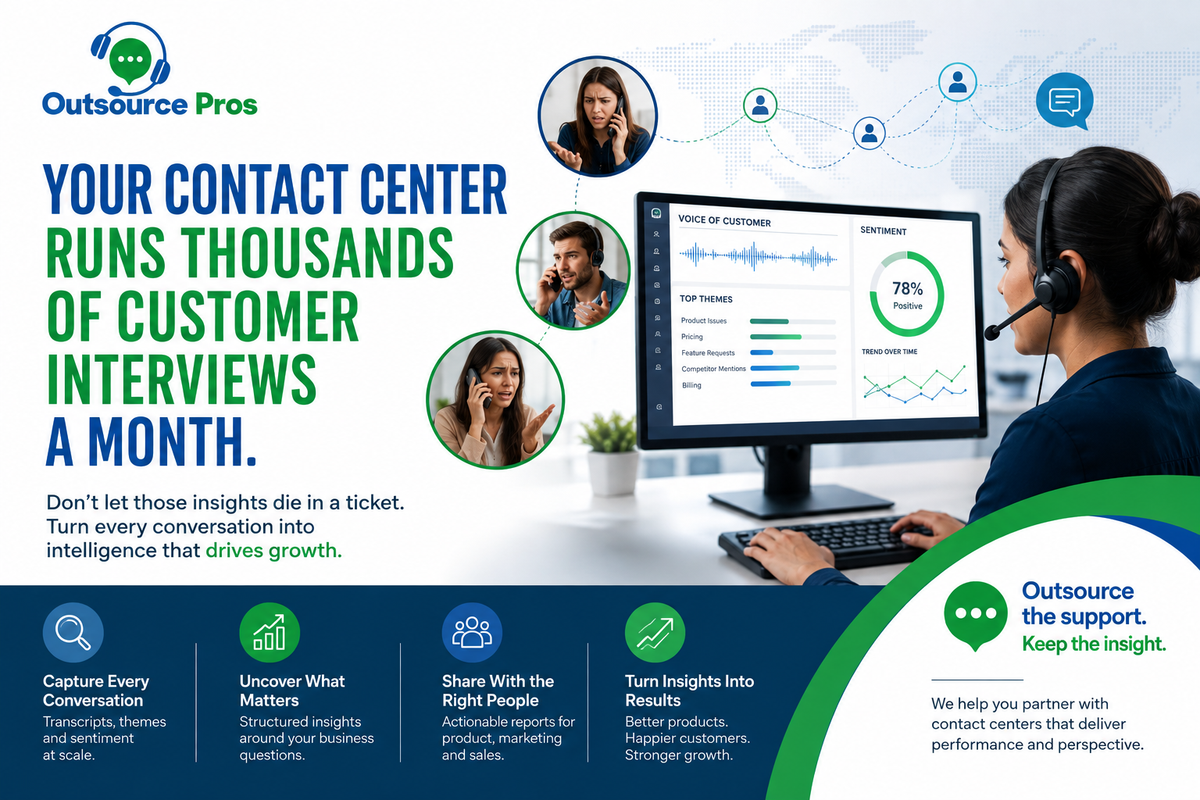
Your Contact Center Runs Thousands of Customer Interviews a Month
Companies spend real money on customer research. Surveys, focus groups, user interviews, win-loss analysis, panels. A mid-market company might run a few dozen structured customer conversations a year and treat the findings as a strategic asset.
That same company's support team has thousands of unstructured customer conversations a month, and throws away nearly all of them.
Every day your agents hear some version of:
"This feature is confusing." "Your competitor does this better." "I almost didn't buy because of..." "This is the third time I've called about this."
The ticket gets resolved. The customer is satisfied. The insight dies with the ticket.
That's a problem in any support organization. But it becomes a structural problem the moment support gets outsourced — and that's the part of this conversation almost nobody has.
Outsourcing doesn't just silo the insight. It relocates it.
When support sits in-house, the intelligence is at least in the building. It's trapped in a department, which is bad, but it's recoverable — a motivated product manager can go sit with the support team for a week and learn more than a quarter of surveys would tell them.
When support moves to a BPO, that stops being possible by default. The conversations now happen inside another company, on their platform, recorded in their systems, summarized by their QA team, and reported to you in the format their standard reporting package produces.
And here's what that standard package contains: average handle time, CSAT, first-contact resolution, service level, occupancy, quality scores.
Notice what's missing. Every one of those metrics describes how efficiently the conversation was handled. None of them describe what the customer actually said.
This isn't the provider failing. It's the contract not asking.
I want to be fair to the provider side here, because the reflex is to read this as vendors withholding something.
They're not. They're delivering exactly what was specified.
I've read a lot of contact center agreements. Nearly all of them define operational metrics in detail — SLA thresholds, measurement windows, service credits, reporting cadence. Almost none of them define how customer insight flows back to the client's product, marketing, and sales functions.
So it doesn't flow. The provider hits every number in the agreement, the account is objectively performing well, and the client is measurably worse informed about their own customers than they were before they outsourced. Both parties are doing what they agreed to. The agreement was just incomplete.
This is the same category of problem as losing operational visibility across outsourced operations — you get what you specified, and the things you didn't think to specify quietly disappear.
What good actually looks like
The providers who do this well aren't doing anything exotic. They're doing four things:
A named owner. Someone on the provider's side owns voice-of-customer reporting as an actual responsibility, not as an extra duty tacked onto the QA lead. Ask who that person is and what their background is. If the answer is "our reporting team can pull that," you've found a provider who will send you a spreadsheet.
Structured contact reasons that you defined. Most providers tag contacts with a disposition taxonomy built for their own operational reporting. That taxonomy answers "what kind of contact was this?" — not "what is this telling us about the product?" The tags need to be designed around your business questions, and revisited quarterly as the product changes.
Direct access, not just summaries. Can your product manager listen to live calls? Can your marketing lead pull thirty transcripts on a specific objection without filing a request? A summary is someone else's interpretation of your customers. It's useful. It is not a substitute for hearing the thing directly.
A cadence with an audience. A monthly insight review with product, marketing, and sales in the room — not a PDF emailed to the vendor manager. The distribution list is what determines whether this is a real function or a deliverable nobody opens.
The AI wrinkle nobody is pricing in
Two things changed in the last eighteen months that make this more urgent, not less.
The good news: interaction data is now machine-readable at a scale that wasn't practical before. Transcription and thematic analysis across every contact — not a 2% QA sample — is genuinely achievable now. The technical barrier that made this expensive is mostly gone.
The complication is subtler, and I don't hear buyers asking about it.
As AI handles more tier-one contacts, the composition of what reaches a human changes. If your bot resolves the simple, high-volume, transactional contacts and escalates the rest, then your human-agent transcripts stop being a representative sample of your customer base. They become a sample of your frustrated, edge-case, or complex-need customers.
That's still valuable data. It's arguably more valuable. But it means something different than it did last year, and if your product team is reading the same monthly report without knowing the sample shifted underneath them, they're drawing conclusions from a changed population. Ask your provider what the AI is resolving, what it's escalating, and whether the deflected conversations are being analyzed at all — or just closed.
Which connects to the question worth asking before any of this: does your provider's AI actually work in production, and can they show you rather than tell you?
The contract terms that make it real
Everything above is a promise until it's an obligation. If you're mid-evaluation, these belong in the agreement:
Data ownership, stated explicitly. Recordings, transcripts, contact tags, QA notes, and any analysis derived from them. Then the newer question: does the provider have the right to train models on your interaction data, and if so, on what terms? This clause is increasingly non-standard and increasingly consequential. Check it. The answer isn't always what you'd assume.
Portability and exit. If you leave in two years, what comes with you and in what format? "Your data is available on request" is not a specification. Ask for the format and the timeline.
Insight reporting as a named deliverable with a defined cadence, audience, and format — sitting alongside the operational SLAs rather than as a courtesy.
Direct access rights for your teams: live call listening, transcript search, and a defined process for ad-hoc pulls.
If you're already mid-contract, most of this can be added at renewal, and some of it a good provider will simply agree to now because it costs them very little and makes them stickier. It's worth the ask either way.
Why this belongs in vendor selection, not implementation
The reason to raise this during evaluation rather than after go-live is that the answer tells you something about the provider that no reference call will.
A provider who fields these questions crisply — who has a named owner, an existing cadence, and a clear position on data ownership — is a provider who has been asked before by clients who treat them as a partner. That's a meaningful signal about the accounts they run.
A provider who looks confused by the question is quoting you a seat price. That's not a disqualification on its own. But it tells you what kind of relationship you're buying, and it should change what you specify in the contract.
It's one of the questions we build into evaluations for clients, alongside the ones covered in our framework for choosing an outsourcing partner.
The reframe
Support gets budgeted as a cost center because that's how it shows up in the P&L. Fine — it does cost money.
But it's also the only function in your company that has an unfiltered conversation with thousands of customers every month, at no incremental research cost, about problems they're experiencing right now. Treating that as overhead to be minimized rather than an asset to be harvested is a decision most companies make by default rather than on purpose.
Outsourcing doesn't have to break that. It breaks it when nobody specifies otherwise.