BPO Is Growing Fast. Customer Experience Outsourcing Isn’t.
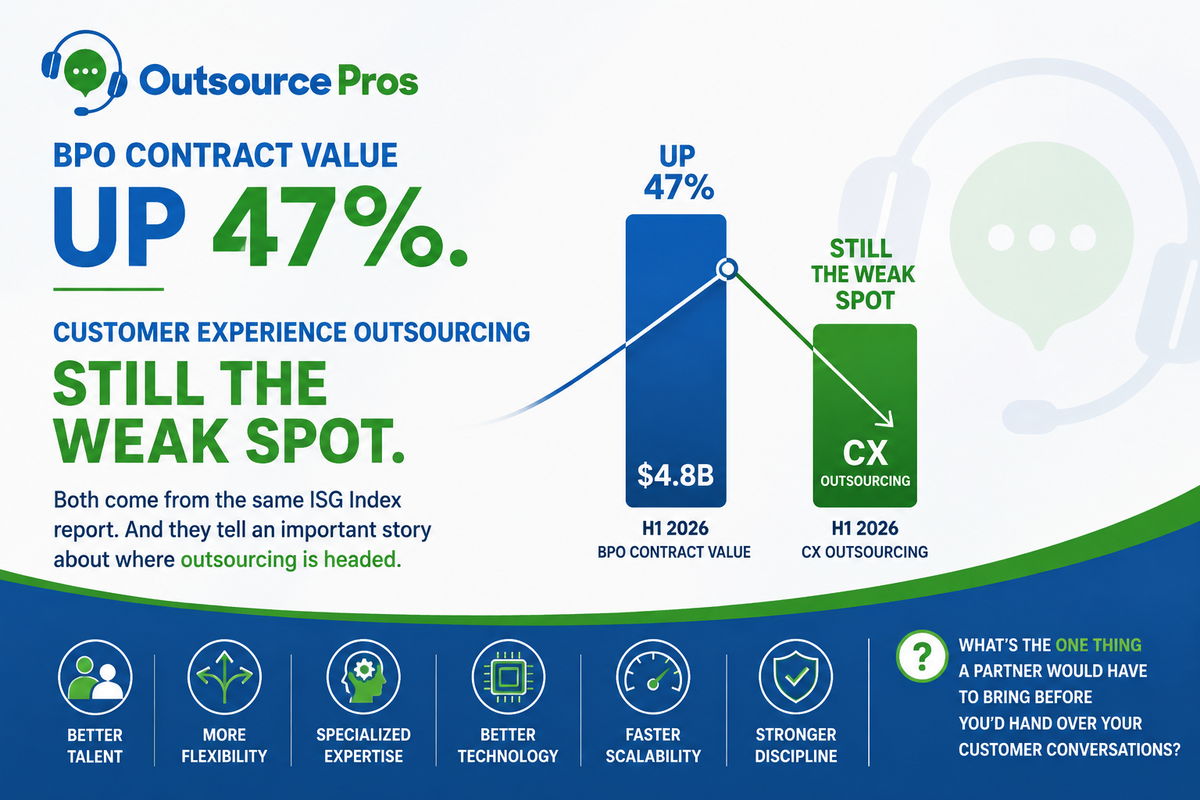
ISG’s 2Q 2026 Index shows BPO annual contract value up 47% in the first half of the year. In the same report, customer experience services declined. Companies haven’t stopped outsourcing. They’ve gotten selective about it — and I think that’s a healthy sign.

Alan started his career in contact centers, spending over a decade managing procurement, vendor partnerships, and operations for a large construction and hospitality company. In 2018, he co-founded Outsource Pros with his mother, Becky, to help businesses simplify outsourcing by connecting them with trusted partners.
ISG released its second-quarter Index in July.
One number in it caught my attention.
BPO annual contract value reached $4.8 billion in the first half of 2026.
Up 47% year over year.
Then there was a second detail, further down in the same report.
Customer experience services declined.
The growth came from back-office functions instead.
Two findings. One report. They seem like they don’t belong together.
I think they belong together completely.
A quick note on what the number measures
Before going further, one distinction worth making.
ISG tracks annual contract value on newly awarded contracts worth $5 million or more.
That’s a measure of what companies are signing.
Not what they’re spending in total.
Which makes it more useful here, not less.
New contracts tell you what buyers are deciding right now.
Companies haven’t stopped outsourcing. They’ve gotten selective.
This was the fastest-growing quarter ISG has ever measured. Combined market ACV hit a record $42.4 billion, up 43%.
In a market moving that fast, CX outsourcing didn’t just grow more slowly.
It went backwards.
So whatever is holding buyers back, a weak market isn’t it.
Look at where the growth landed and a pattern shows up quickly.
Finance and accounting. IT support. Data operations. Claims administration.
Back-office work.
That work tends to share a few traits:
- It’s well-defined and repeatable
- Quality is measurable in objective terms
- The cost comparison is straightforward
- A mistake is recoverable
- No customer ever sees it happen
Customer experience is none of those things.
Handing off a task is not the same as handing off a relationship
When you outsource a back-office process, you’re outsourcing a task.
When you outsource customer support, you’re outsourcing a relationship.
Every interaction is a live representation of your brand.
Delivered by someone who doesn’t work for you.
To a customer who has no idea a vendor is involved, and wouldn’t care if they did.
The risk looks completely different:
- A bad interaction damages a relationship you paid to acquire
- The damage often surfaces in retention data months later
- Quality is contextual, not binary — “correct” and “good” aren’t the same thing
- Product knowledge takes months to build and leaves with every agent who quits
- Recovery is expensive, and sometimes not possible
So when a company signs off on outsourcing accounts payable in a few weeks and spends nine months deliberating over a support program, that isn’t inconsistency.
It’s an accurate read of the downside.
The cost pitch is running out of room
For most of this industry’s history, the easiest pitch in BPO was cost.
Move the work somewhere cheaper. Reduce the cost per agent. Show the savings on a slide.
Call it a successful outsourcing strategy.
That pitch is getting harder to make, for a few reasons at once.
Labor arbitrage has compressed. Wages in the established offshore markets have risen, and the gap that made the math obvious a decade ago is narrower now.
Buyers have been burned. Plenty of CX leaders have lived through a program that hit its cost target and missed everything else. Attrition running hot. Product knowledge never landing. CSAT sliding a couple of points a quarter until somebody finally noticed.
And automation moved the baseline. If the cheapest possible resolution is now a well-built self-service flow, then cheaper humans isn’t the compelling offer it used to be.
Cost savings has gone from a reason to outsource to an assumption.
It gets a provider into the conversation.
It doesn’t win it.
What a partner has to bring
Here’s the standard I think follows from all of this.
If you’re going to hand your customer relationships to another company, saving money isn’t enough.
The provider has to bring something you can’t easily build yourself.
Better talent. Not “we hire great people.” A hiring funnel and a retention record you can see in numbers. Ask for attrition by program, not company-wide — the company-wide figure is an average, and averages hide the accounts in trouble.
More flexibility. The ability to move with your volume rather than your contract cycle. Seasonal ramps, launch spikes, an unplanned Monday. A good partner does this structurally better than an internal team because they’re pooling demand across clients. If they can’t, you’re paying margin for staffing you could have handled yourself.
Specialized expertise. Depth in your industry, your regulatory environment, your customer. A provider who has run regulated healthcare or insurance support knows the failure modes already. A generalist learns them on your customers.
Better technology. Quality monitoring across full contact volume instead of a sampled handful. Workforce management that actually forecasts. Analytics that surface why customers are calling. Not a dashboard login.
Faster scalability. Standing up a competent team in weeks rather than quarters, with training infrastructure that makes it repeatable instead of heroic.
Stronger operational discipline. The unglamorous one, and often the most valuable. Calibration. Coaching cadence. Root-cause analysis on escalations. Honest reporting when a number moves the wrong way.
Every item on that list is a capability.
None of them is a rate.
The question I’d ask
If a provider’s entire value proposition is that they cost less, there’s a fair question on the table.
Why outsource it at all?
You can hire people. You can buy the software. You can build the QA program.
Harder and slower, yes. But not impossible. And you’d keep full control of the customer relationship while you did it.
The case for outsourcing CX only holds when the partner brings something you genuinely can’t replicate at reasonable cost or speed.
If a provider can’t answer that clearly, the answer is probably that you shouldn’t.
That one question filters out a surprising number of providers before anyone gets to pricing.
What I think the numbers are actually saying
The growth in BPO tells us outsourcing isn’t going anywhere. The business case is real and companies are acting on it.
The weakness in CX tells us something more interesting.
Buyers are finally demanding more from it.
They’ve stopped accepting a lower cost per agent as a strategy. They’re asking what a partner brings that they couldn’t build themselves. And they’re willing to wait until somebody gives them a good answer.
That’s a higher bar.
I think it’s the right one.
Providers who can clear it are going to do well. The ones still leading with a rate card are competing on a pitch the market has stopped buying.
That’s a big part of what we do at Outsource Pros.
We work across a network of vetted contact centers and CX providers, and we evaluate them from the buyer’s side — the things that don’t always make it into the sales presentation. Attrition on accounts like yours. What the operations leader says when the salesperson isn’t in the room. How the provider behaved on a program that struggled.
There’s no cost to the client.
If you’re weighing whether to outsource customer experience, or reconsidering a program you already have, let’s talk. We’ll look at it with you and tell you what we see.
Source: ISG Index™, 2Q 2026 (July 9, 2026)