From Cost Center to Growth Engine: How the Best BPO Partners Are Redefining CX
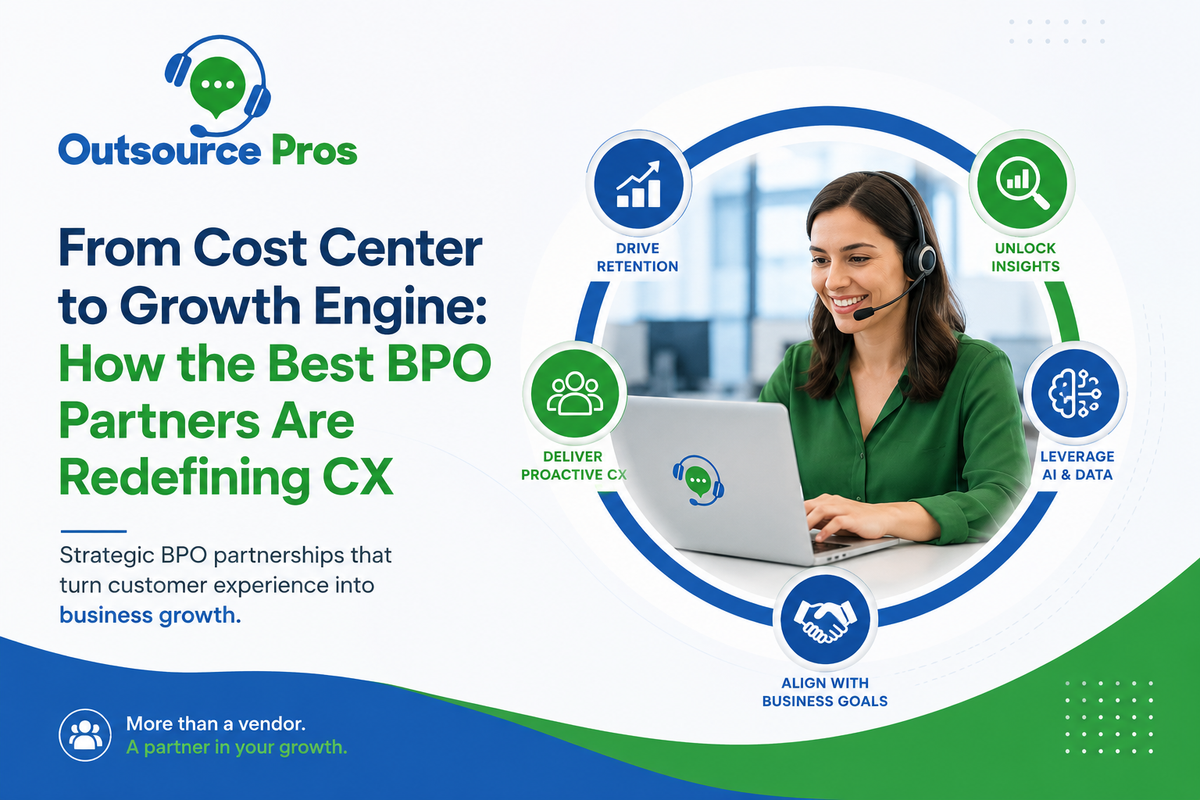
Most companies still evaluate BPOs based on cost. The smartest companies evaluate them based on customer impact. The best outsourcing partners today are helping brands improve retention, uncover operational issues, support AI-driven workflows, and turn customer support into a growth engine. In our latest blog, we break down how strategic BPO partners are redefining modern CX.

Alan started his career in contact centers, spending over a decade managing procurement, vendor partnerships, and operations for a large construction and hospitality company. In 2018, he co-founded Outsource Pros with his mother, Becky, to help businesses simplify outsourcing by connecting them with trusted partners.
For years, outsourcing was viewed through one lens: cost reduction.
Companies moved customer support offshore to lower labor expenses, reduce overhead, and increase coverage hours. Success was measured almost entirely by lower cost per contact.
But that model is changing fast.
Today, the best BPO partners are no longer acting as outsourced labor providers. They are becoming part of a company’s customer experience infrastructure — helping brands improve retention, uncover operational problems, increase customer lifetime value, and create better experiences at scale.
The companies winning in CX today are not asking:
“How cheap can we make support?”
They are asking:
“How can support help us grow?”
That shift changes everything about how BPO partnerships should be evaluated.
The Old Model: BPO as Cost Arbitrage
The traditional outsourcing model was simple.
Move customer support to a lower-cost region.
Reduce payroll.
Maintain acceptable service levels.
Repeat.
In many cases, vendors competed almost entirely on price.
The problem is that low-cost outsourcing often created new operational issues:
- High agent turnover
- Poor product knowledge
- Reactive support models
- Limited reporting
- Low customer satisfaction
- Minimal accountability for business outcomes
Support teams became disconnected from the actual customer journey.
And because many vendors were measured only on handle time and staffing efficiency, there was little incentive to improve customer retention, reduce churn, or identify friction points inside the business.
The result was a support operation that functioned more like a utility than a strategic asset.
The New Model: BPO as CX Infrastructure
The strongest BPO partners today operate very differently.
They are embedded into the client’s operational strategy.
Instead of simply answering tickets, they help companies:
- Improve customer retention
- Identify recurring customer pain points
- Reduce churn drivers
- Increase first-contact resolution
- Improve onboarding experiences
- Surface operational inefficiencies
- Support AI-driven workflows
- Deliver actionable customer insights
The best providers now combine:
- Human support teams
- AI and automation tools
- Real-time analytics
- QA and compliance monitoring
- Workforce optimization
- Customer journey visibility
This is especially important as companies scale.
Most growing businesses eventually reach a point where customer experience becomes too operationally complex to manage through internal teams alone. That is where strategic BPO partners create value.
Not as a vendor.
As operational infrastructure.
How Top BPO Partners Use Data to Drive Retention
One of the biggest differences between average providers and strategic partners is how they use customer data.
Traditional BPOs report basic metrics:
- Average handle time
- Service levels
- Occupancy
- Tickets closed
Strategic BPOs go much deeper.
They analyze customer conversations to identify:
- Churn signals
- Product frustrations
- Escalation trends
- Failed workflows
- Billing confusion
- Sales objections
- Onboarding drop-off points
- Compliance risks
Modern QA and analytics platforms now allow leading providers to review 100% of customer interactions instead of manually auditing only a small sample.
That changes the role of customer support entirely.
Support becomes an early warning system for the business.
The best CX organizations use this intelligence to improve:
- Product decisions
- Customer retention strategies
- Training programs
- Automation opportunities
- Revenue expansion efforts
When done correctly, support conversations become one of the most valuable sources of operational insight inside the company.
What Proactive CX Looks Like in Practice
Reactive support waits for customers to complain.
Proactive CX identifies problems before they become escalations.
Leading BPO partners now help clients:
- Detect customers likely to churn
- Trigger retention outreach automatically
- Identify failed onboarding journeys
- Escalate high-risk accounts earlier
- Recommend workflow improvements
- Spot compliance concerns in real time
- Use AI agent assist tools to improve live interactions
For example:
A subscription company may discover through call analytics that customers who contact support twice during onboarding are significantly more likely to cancel within 60 days.
A strategic BPO partner does not simply report that trend.
They help build workflows to intervene earlier:
- Escalate vulnerable customers
- Improve onboarding communication
- Retrain agents
- Simplify confusing processes
- Reduce friction points
That is no longer “customer support.”
That is customer retention infrastructure.
How to Find a BPO Partner With a Growth Mindset
Many outsourcing providers still operate under the old model.
Choosing the wrong partner can create long-term operational damage even if the pricing looks attractive upfront.
When evaluating BPO providers, companies should look beyond seat costs and ask deeper questions:
- How do they measure customer outcomes?
- What analytics capabilities do they provide?
- Can they support AI-enabled workflows?
- How do they reduce churn?
- How do they improve quality at scale?
- What operational insights do they bring proactively?
- How involved are they post-launch?
- Do they understand your industry and customer journey?
The best BPO partnerships are collaborative.
They involve:
- Continuous optimization
- Shared accountability
- Operational transparency
- Long-term CX planning
- Strategic alignment with business goals
And importantly, the right partner should feel like an extension of your internal team — not a disconnected third party.
The Future of CX Will Be Hybrid
The future of customer experience is not AI alone.
And it is not human support alone.
The strongest CX organizations are building hybrid models where:
- AI handles repetitive workflows
- Humans manage complex interactions
- Analytics drive decision-making
- Automation improves speed
- Strategic BPO partners coordinate the operation
That is why BPO selection matters more than ever.
The right partner can help a business scale faster, improve customer loyalty, and create operational advantages competitors cannot easily replicate.
The wrong partner simply lowers costs while slowly damaging the customer experience.
Final Thoughts
Customer support is no longer just a cost center.
It is becoming one of the most important operational growth levers inside modern companies.
The businesses that recognize this early are building smarter CX ecosystems with partners that contribute far beyond staffing.
At Outsource Pros, we help companies identify strategic BPO partners that align with their operational goals, customer expectations, and long-term growth plans — not just their budget.
Because the right outsourcing partner should help your business grow, not just spend less.