Omnichannel Contact Center: What It Is and Why Your Customers Now Expect It
Customer expectations have changed. They no longer think in terms of phone, email, chat, or social media—they expect every interaction to feel connected. In this guide, we break down the difference between multichannel and omnichannel customer service, the six channels customers expect in 2026, and how to evaluate BPO partners that can deliver a seamless customer experience across every touchpoint. Discover why omnichannel contact centers are becoming a competitive advantage and whether it's smarter to build or buy your omnichannel CX strategy.

Alan started his career in contact centers, spending over a decade managing procurement, vendor partnerships, and operations for a large construction and hospitality company. In 2018, he co-founded Outsource Pros with his mother, Becky, to help businesses simplify outsourcing by connecting them with trusted partners.
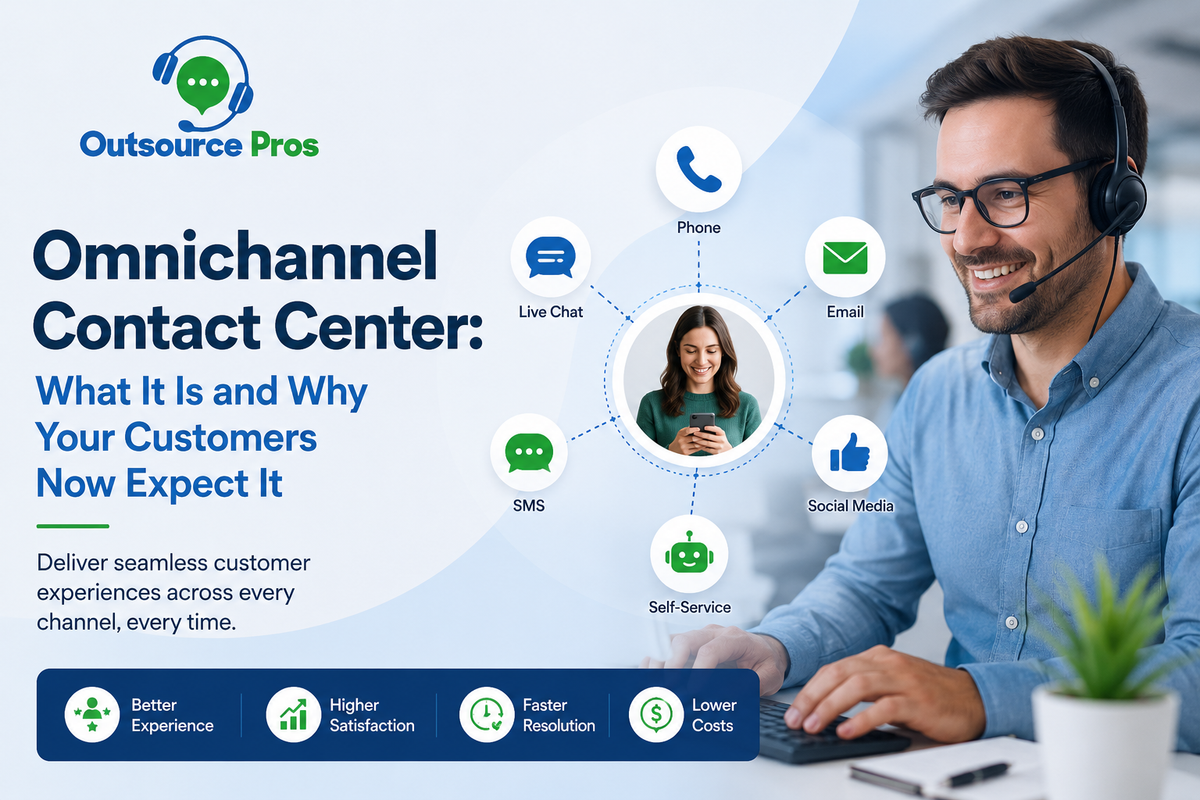
Customers no longer interact with businesses through a single channel.
A customer might discover your company through social media, start a conversation through website chat, follow up via email, and later call your support team. They expect every interaction to feel connected.
The problem is that many businesses still operate disconnected communication channels. The customer has to repeat information, explain their issue multiple times, and start over every time they switch channels.
That frustration is exactly why omnichannel customer experience has become one of the most important priorities for customer service leaders in 2026.
If your contact center strategy is not omnichannel, your competitors are already gaining an advantage.
What Is an Omnichannel Contact Center?
An omnichannel contact center allows customers to move seamlessly between communication channels while maintaining context and conversation history.
Regardless of whether a customer contacts your business through phone, email, chat, SMS, social media, or a mobile app, agents can view previous interactions and continue the conversation without interruption.
The goal is simple:
Make the customer feel like they are interacting with one company—not six different departments.
Example of Omnichannel Customer Service
A customer:
- Starts a chatbot conversation on your website
- Receives a follow-up text message
- Sends additional information by email
- Calls your support line the next day
With an omnichannel contact center, the agent sees the complete interaction history immediately.
The customer does not need to repeat their story.
The experience feels effortless.
Multichannel vs Omnichannel: What's the Difference?
Many companies believe they already have an omnichannel strategy because they support multiple communication channels.
In reality, they have a multichannel strategy.
The distinction matters.
Multichannel Contact Center
A multichannel contact center offers several communication options:
- Phone
- Chat
- SMS
- Social media
However, each channel operates independently.
Customer information is often siloed between systems, forcing agents and customers to start from scratch when switching channels.
Omnichannel Contact Center
An omnichannel contact center connects all channels through a unified customer experience platform.
Benefits include:
- Shared customer history
- Unified customer profiles
- Consistent service across channels
- Faster resolution times
- Better customer satisfaction scores
- Reduced customer effort
The customer journey continues across channels without losing context.
That's the difference customers notice.
The 6 Channels Customers Expect in 2026
Customer preferences continue to evolve, but six communication channels have become standard expectations.
1. Voice Support
Phone support remains essential for complex issues, escalations, healthcare, financial services, insurance claims, and high-value transactions.
Despite the growth of digital channels, voice remains one of the most important components of customer experience.
2. Live Chat
Customers expect immediate assistance while browsing your website.
Live chat often delivers faster resolution and higher conversion rates than traditional email support.
3. Email Support
Email remains critical for documentation, follow-up communication, and non-urgent requests.
Many customers still prefer email for account management and detailed inquiries.
4. SMS Messaging
Text messaging continues to grow because of its convenience and high response rates.
Customers increasingly prefer receiving updates, reminders, appointment confirmations, and support communications through SMS.
5. Social Media Support
Customers frequently reach out through:
- X
- TikTok
Many expect responses within hours—not days.
For some brands, social media has become a primary support channel.
6. AI-Powered Self-Service
Modern consumers expect immediate answers.
Knowledge bases, virtual assistants, chatbots, and AI-powered support tools help customers resolve issues without waiting for an agent.
The strongest customer experience strategies combine AI automation with human support when escalation is needed.
What Omnichannel Customer Experience Looks Like in Practice
Consider a healthcare organization scheduling patient appointments.
A patient visits the website and starts a chatbot conversation.
The chatbot collects basic information and offers appointment options.
The patient leaves before booking.
The next day, the patient receives an SMS reminder and clicks a link to continue.
Questions arise, so the patient initiates a live chat.
The chat agent already sees the previous interaction history.
The appointment is scheduled.
A confirmation email is automatically sent.
The entire experience feels connected.
That's omnichannel customer experience.
No repeated questions.
No disconnected systems.
No customer frustration.
Benefits of an Omnichannel Contact Center
Organizations that implement omnichannel customer service often experience measurable improvements across multiple KPIs.
Higher Customer Satisfaction
Customers value convenience and consistency.
Reducing friction increases satisfaction scores and brand loyalty.
Faster Resolution Times
Agents spend less time gathering information and more time solving problems.
This leads to shorter handle times and improved efficiency.
Increased Customer Retention
Customers are more likely to stay with companies that provide effortless service experiences.
Better Agent Productivity
Agents gain access to a complete customer history, reducing repetitive work and improving performance.
Improved Reporting and Analytics
Unified data provides greater visibility into:
- Customer journeys
- Channel performance
- Resolution trends
- Customer sentiment
- Operational bottlenecks
How to Evaluate a BPO's Omnichannel Capabilities
Not every outsourcing provider can deliver a true omnichannel customer experience.
When evaluating BPO partners, ask these questions.
Which Channels Do You Support?
Verify support for:
- Voice
- Live chat
- SMS
- Social media
- AI and self-service tools
What CRM Platforms Do You Integrate With?
Leading providers should have experience with platforms such as:
- Salesforce
- Zendesk
- HubSpot
- Microsoft Dynamics
- ServiceNow
Can Agents View Unified Customer Histories?
This is one of the most important omnichannel capabilities.
If agents cannot view previous interactions across channels, the experience is not truly omnichannel.
What AI Capabilities Are Available?
Look for:
- Agent assist technology
- AI-powered quality assurance
- Conversation analytics
- Chatbots
- Voice bots
- Automated workflows
Can You Provide Omnichannel Reporting?
You should be able to measure performance across all channels from a single reporting environment.
Cost of Building vs Buying an Omnichannel Contact Center
Many companies underestimate the complexity of building omnichannel customer support internally.
Creating a complete omnichannel operation often requires:
- Contact center software
- CRM integration
- Workforce management tools
- AI solutions
- Reporting platforms
- IT support resources
- Hiring and training staff
For many organizations, outsourcing to an established omnichannel BPO provider is significantly faster and more cost-effective.
Companies often reduce operating costs by 30% to 50% while gaining immediate access to experienced agents, advanced technology, and scalable support operations.
The right outsourcing partner can deliver capabilities that would take months—or years—to build internally.
The Future of Customer Experience Is Omnichannel
Customer expectations have changed permanently.
They no longer think in terms of channels.
They simply expect help when and where they need it.
Companies that continue operating disconnected communication channels will struggle to meet those expectations.
Organizations that embrace omnichannel customer experience will improve customer satisfaction, increase loyalty, and create a competitive advantage.
The question is no longer whether your business needs an omnichannel strategy.
The question is whether your current customer experience is keeping up with what customers already expect.
Find Omnichannel-Ready BPO Partners
Finding the right omnichannel contact center partner can be challenging.
At Outsource Pros, we help companies identify, evaluate, and compare vetted BPO providers with proven omnichannel customer experience capabilities.
Whether you need voice, chat, email, SMS, social media support, AI-powered automation, or a complete customer experience transformation, we can help you find the right partner.
No fees. No contracts. Just access to the right outsourcing providers for your business.
Contact Outsource Pros today to explore omnichannel-ready BPO partners and build a customer experience your customers will actually remember.