Healthcare Contact Center Outsourcing: What HIPAA Compliance Actually Requires
By Alan Adler —
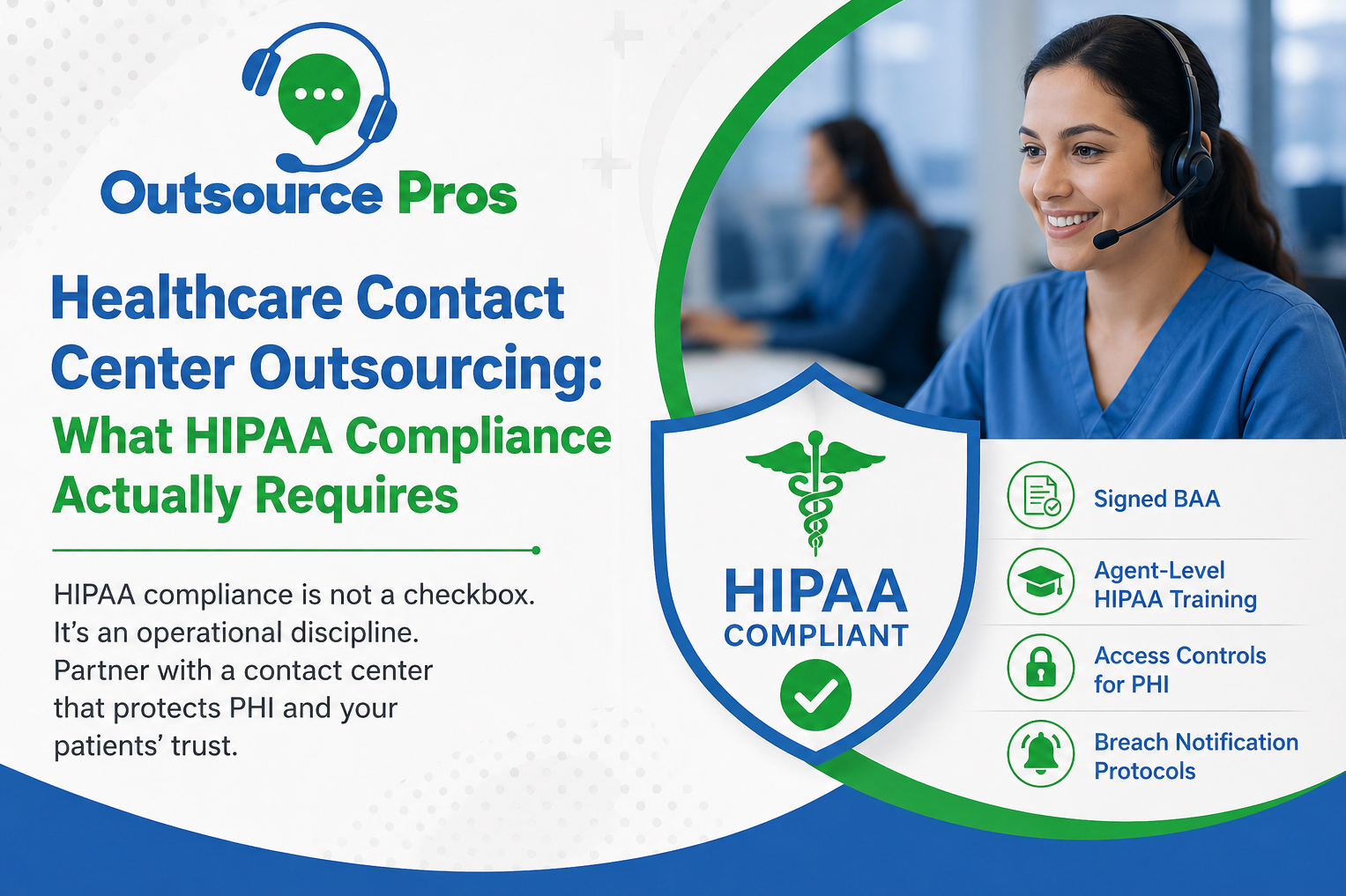
HIPAA compliance in a healthcare contact center is not a checkbox. It is an operational discipline that affects every interaction involving patient data. Too many healthcare organizations choose outsourcing vendors based on pricing or size without properly evaluating compliance readiness, access controls, breach protocols, and agent-level HIPAA training. In this article, we break down what healthcare contact center outsourcing actually requires, the red flags to watch for, and how to identify BPO partners that are truly prepared for healthcare operations.
Healthcare organizations are under pressure from every direction.
Patients expect faster response times. Staffing costs keep rising. Support volumes continue to grow across phone, chat, email, and member services. And at the same time, healthcare providers, payers, and healthcare technology companies are being asked to protect patient data more carefully than ever before.
That is why healthcare contact center outsourcing has become a major focus for healthcare leaders looking to scale support operations without sacrificing compliance or patient experience.
But there is one mistake companies continue to make:
They assume HIPAA compliance is just another checkbox.
It is not.
HIPAA compliance inside a healthcare contact center is an operational discipline. It affects hiring, training, infrastructure, workflows, reporting, escalation procedures, and daily agent behavior.
And the reality is that many BPO vendors marketing themselves as “healthcare-ready” would struggle to pass a serious compliance audit.
What HIPAA Compliance Actually Means in a Healthcare Contact Center
A HIPAA-compliant contact center is not simply a vendor willing to sign paperwork.
It is an organization that has built its operations around protecting Protected Health Information (PHI) at every level.
Every conversation, support ticket, patient interaction, screen recording, QA review, and workflow involving PHI creates compliance exposure.
Healthcare organizations outsourcing customer support, patient scheduling, claims support, member services, billing inquiries, nurse triage support, or healthcare intake operations need partners that understand those risks operationally — not just legally.
When evaluating healthcare BPO providers, every serious vendor should be able to immediately provide:
- A signed Business Associate Agreement (BAA)
- Documented HIPAA training programs at the agent level
- PHI access control policies
- Secure authentication procedures
- Breach notification protocols
- Call recording and storage policies
- Audit trail procedures
- Secure workstation standards
- Device and endpoint management policies
- Workforce monitoring and compliance reporting documentation
If a vendor cannot clearly produce these materials during the evaluation process, they are not prepared for healthcare operations.
The Biggest Mistake Companies Make When Outsourcing Healthcare Support
Many organizations evaluate healthcare outsourcing providers the same way they would evaluate a standard customer service vendor.
That approach creates major risk.
Healthcare contact centers should not be selected based only on:
- Lowest hourly rate
- Largest global footprint
- Brand recognition
- Fastest implementation timeline
- Generic RFP responses
The vendors that look impressive in presentations are not always the vendors with the strongest compliance culture.
In many cases, mid-sized healthcare-specialized BPOs outperform larger providers because they maintain tighter operational oversight, stronger accountability, lower agent turnover, and more flexible compliance processes.
This becomes especially important when dealing with:
- Medicare and Medicaid support
- Claims processing
- Patient scheduling
- Pharmacy support
- Healthcare intake
- Prior authorization support
- Member services
- Care coordination
- Sensitive billing discussions
- Multilingual healthcare support
In healthcare outsourcing, operational discipline matters more than marketing size.
Questions Every Healthcare Company Should Ask a BPO Vendor
Most companies ask surface-level questions during vendor evaluations.
That is not enough for healthcare operations.
The better approach is to pressure test how the vendor actually handles PHI in real-world scenarios.
Here are some of the most important questions healthcare organizations should ask:
How is PHI access restricted internally?
Not every employee should have access to healthcare data.
Strong vendors maintain role-based access controls, permission segmentation, and strict authentication requirements.
How often are agents retrained on HIPAA procedures?
HIPAA training should not happen once during onboarding and disappear forever.
Healthcare-focused contact centers typically conduct ongoing compliance refreshers, testing, and monitoring.
What happens during a suspected breach?
A qualified healthcare BPO should already have documented escalation paths, investigation procedures, and notification timelines.
If the answer sounds vague, that is a problem.
How are remote agents secured?
Remote healthcare support environments require additional controls, including:
- Locked-down systems
- VPN requirements
- Multi-factor authentication
- Screen monitoring
- Device restrictions
- Secure work environment policies
Can the vendor provide healthcare references?
Experience matters.
A vendor supporting retail customer service is very different from one supporting healthcare patients, members, providers, or claims operations.
Why Healthcare Contact Center Outsourcing Is Growing
Despite compliance concerns, healthcare outsourcing continues to grow rapidly because healthcare organizations need operational flexibility.
The right outsourcing partner can help healthcare companies:
- Reduce operational costs
- Expand support coverage
- Add multilingual support
- Improve patient response times
- Scale seasonal enrollment operations
- Reduce internal staffing pressure
- Add after-hours support
- Improve member experience
- Support omnichannel communication
- Integrate AI-assisted workflows responsibly
But healthcare organizations are becoming more selective.
The conversation is shifting from:
“Who can provide the cheapest labor?”
to:
“Who can protect patient data while delivering reliable patient experiences at scale?”
That is a much higher standard.
The Role of AI in HIPAA-Compliant Healthcare Contact Centers
AI is becoming a larger part of healthcare customer support operations, but it also introduces additional compliance considerations.
Healthcare organizations should ask vendors:
- Where is AI processing patient data?
- Is PHI being stored by third-party AI tools?
- Are AI interactions logged securely?
- What human oversight exists?
- How are AI-generated summaries protected?
- Are vendors using approved secure environments?
AI can improve routing, transcription, QA scoring, and workflow automation.
But healthcare support still requires strong human oversight, especially during sensitive patient interactions, escalations, billing issues, and compliance-heavy workflows.
The best healthcare contact centers treat AI as a support layer — not a replacement for operational controls.
Why Vendor Selection Matters More Than Ever
The cost of choosing the wrong healthcare outsourcing partner is enormous.
A weak vendor can create:
- HIPAA exposure
- Regulatory penalties
- Patient trust issues
- Operational disruption
- Security vulnerabilities
- Poor patient experiences
- Brand damage
- Compliance failures
And unfortunately, many companies do not discover those weaknesses until after implementation.
That is why healthcare organizations are increasingly relying on experienced outsourcing advisors who already know which vendors have real healthcare operational maturity and which ones simply market themselves well.
Outsource Pros Helps Companies Identify HIPAA-Ready Contact Center Partners
At Outsource Pros, we help healthcare organizations identify vetted healthcare contact center outsourcing partners that meet strict operational and compliance expectations.
We help companies evaluate:
- HIPAA readiness
- Healthcare experience
- Security standards
- AI capabilities
- Scalability
- Geographic fit
- Language support
- Operational maturity
- Workforce models
- Long-term partnership alignment
Because in healthcare outsourcing, compliance is not optional.
And choosing the right partner is not something companies should gamble on.